Showing posts with label nix. Show all posts

July 14, 2017

Nines Trick Unveiled

A while back John Stevens asked me if I would write a guest post for Table Talk Math. Of course I was happy to do so. I knew I wanted to share the process of exploring a trick to figure out the math behind it so parents would be encouraged to engage their kids in asking why and building on conceptual knowledge rather than being tempted to tell kids a procedure. After some considering I opted against any of the tricks in the book and I decided on the nines trick. You know the one where you use your fingers? This one:

Image result for 9 multiplication finger trick

I had a great time figuring out why it works and I don't want to rob you of that opportunity to explore! After you've played feel free to read my guest post and leave a comment if you explained it differently.

January 14, 2015

Nix the Tricks: Second Edition

It's finally officially here!!

I've been hard at work on the long overdue update. While the brunt of the writing got done in November as I'd hoped, there were images to design plus editing, editing and more editing that dragged on. But I think the final product is worth the wait (on your part) and the effort (on mine).

The second edition includes:

  • 29 new tricks.
  • Updates to several tricks from the first edition.
  • A new chapter organization method that's more balanced and  aligned with strands of topics.
  • A conclusion, including testaments from teachers nixing tricks in their own classrooms!

The new book is available in a variety of formats. The regular size pdf and tablet/kindle friendly pdf are available for free download. (I updated both today for some minor typos if you've been paying attention and already downloaded one.) The paperback is now 100 pages! You can order it directly from CreateSpace. It will be on Amazon soon (they need a few days to process). This edition is twice as long as the first, but not twice as expensive! (You're welcome.)

I can't possibly begin to thank everyone who has helped me get here. Michael Fenton did an impressive amount of editing so he gets a personal shout out - Thanks Michael! But the biggest thank you has to go to every single person who so much as mentioned this project to someone else. I never imagined how quickly or how widely word would spread. There were over 9,000 downloads of the first edition directly from the website (which launched just over a year ago). I cannot begin to imagine how that number extrapolates to how many people have read the book - between people emailing pdfs, printing copies and downloading from other sites that have posted the pdf.* It amazes me every time someone outside the MTBoS tells me that they've heard of the book. And as I've done no advertising, all of that is you.

Thank you all. Good luck nixing tricks and I hope to hear from you soon with successes or struggles (or typos, though I can't bear to typeset this thing another time this month). I will be at NCTM Boston and TMC and I'm always around on twitter.


*Which is in accordance with the copyright so long as the title and copyright pages are included and the download is free. More sharing is always better, but given the choice I'd rather people provide a link to NixTheTricks.com so visitors have access to other resources including updates!

November 4, 2014

November Goal

First, an announcement:

Nix the Tricks is now available in French!

The translation is titled Terminé les Trucs (you have no idea how much work it took to find a title that I was happy with, thanks for everyone who helped brainstorm). Caroline Arcand has been hard at work translating the finalized document. I learned a few new things - did you know the acronym for multiplying binomials is PIED in French instead of FOIL? Whether it's a foot or a fencing tool it's still a trick, so now those who speak French in math class can learn alternatives. The translation is available at the same download page as the English version; share it with all your French friends!

Second, my goal:

I'm setting a new NaNoWriMo goal - 30 new tricks in 30 days. Luckily (or unluckily?) we already have that many tricks described in the For Review google doc. So my goal for the month is less about writing and more about formatting. Because of this I have a stretch goal - the Vocabulary google doc is filled with great definitions - what if this was a glossary at the end of the book? My bet is that if someone filled in that document with terms in the book, as a community we could build some great definitions. If you are willing to be that someone, please leave a comment.

So, please hold me accountable! Tweet me (@crstn85) occasionally this month to ask me whether I'm working on edit, typesetting or images that day, because I should be working on one of those every day to reach this goal!

August 5, 2014

TMC: Nix the Tricks

I got to give a presentation on Nix the Tricks for the first time at Twitter Math Camp. I was pleased how well attended the session was and feel the need to apologize to all those people for being my "first period class." Thank you for your enthusiasm, patience, understanding and feedback. Second period is going to go much better but I'm hopeful that the guinea pigs still gained something from the experience.

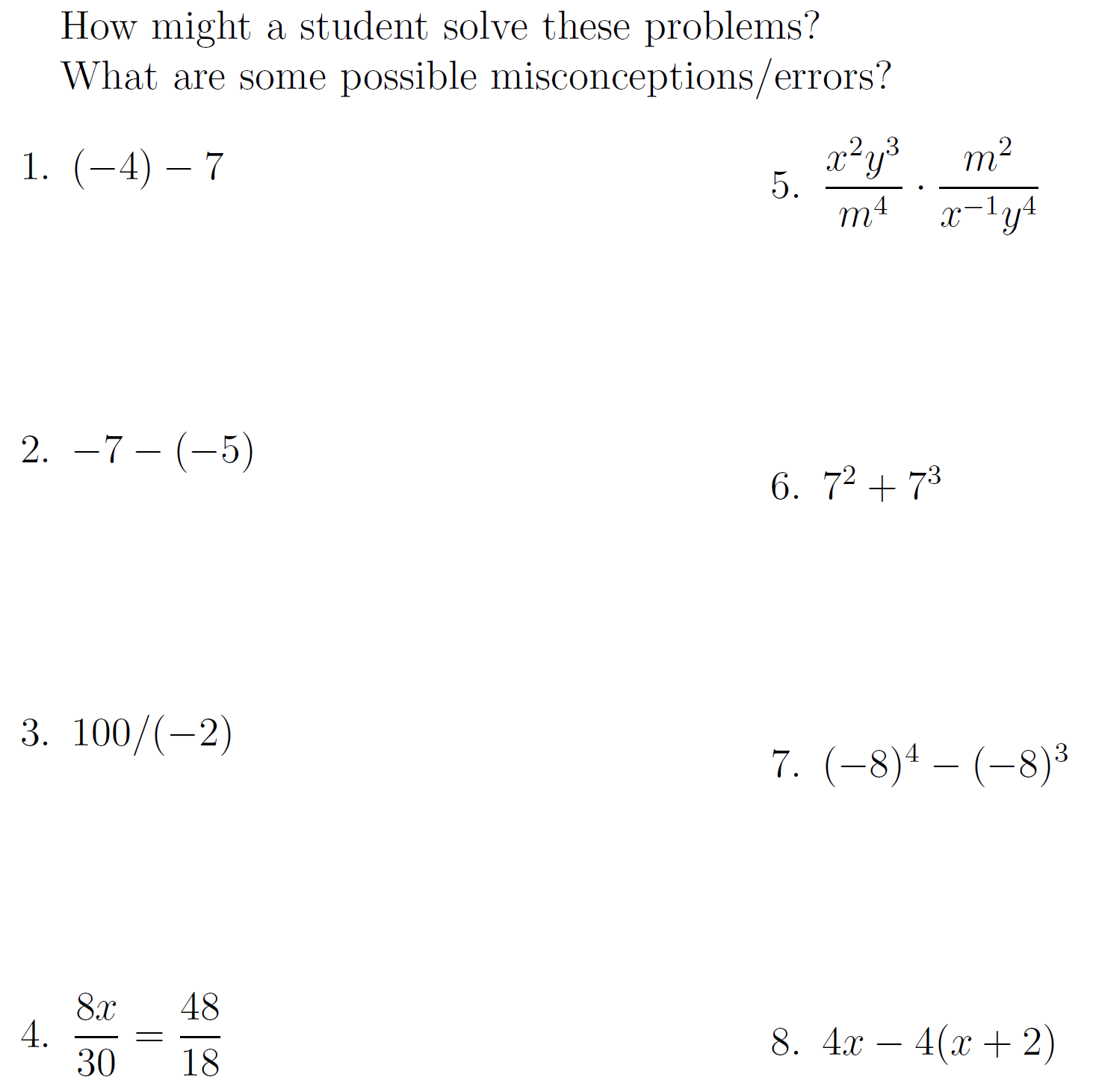
We started the session with groups discussing the following problems:


They didn't know it at the time, but these were all problems that I chose from Math Mistakes with Michael's assistance because we felt the mistakes students made were a consequence of tricks they had learned. Here's a place where I need your help - I would love to have lots of examples of how students solve these problems. Having a single mistake to hold up and say, "I hypothesize this kid made this mistake for this reason." and then conclude, "Therefore no one should use tricks ever." is not good logic. But having a pile of mistakes that correlate to a variety of tricks? That would be more convincing. (I should also read those articles that I saved on research about understanding, as that's even better logic. Time has been at a real premium the past few months...) Feel free to check out the slides which match problem to mistake to trick. (Next time I plan to include more info on how to nix the tricks, not just why tricks are bad.)

We then got into some great conversations about long division, the multiple methods for teaching it and the necessity for teaching the standard algorithm in preparation for polynomial division. I love listening to people talk about areas of math I don't teach and seeing how it relates to what I know. I guess I'm not the only one:


These conversations are the aspect of Nix the Tricks that I've loved the most. People coming together to think deeply about how to teach something students find challenging. Because people don't invent tricks for things kids can do easily; tricks are in place because someone thought the understanding was too hard (for the kids or to teach). I'm wondering how to get that conversation going in a room full of teachers who don't know each other and who teach different things. There were many participants interested in this conversation but not everyone. To differentiate I could have each group pick one of the 8 problems from the beginning and decide how they would teach a lesson around that problem for understanding? But I'll have already talked about the related mistakes and tricks and how to avoid them. Although that sounds ambitious for an hour, perhaps I'll only have skimmed how to avoid them and it would make sense for people to dig deeper...

I leave you with some questions:
1) Can you give one, some or all of the 8 questions above to one, some or all of your kids (at home or in school) and then share their mistakes with me? I'll even give you a form to make it easy to share out. Also, if you know of anyone who already has this type of data I'd love to see it!

2) I don't want a Nix the Tricks presentation to be about me telling people how to teach, but instead to get people thinking and interested in engaging on the site. How can I get teachers to talk to each other in small groups about nixing tricks? Is this the best way to get people interested in having continued conversation on the topic?

April 30, 2014

NCTM Proposal

The National Council of Teachers of Mathematics is having their national conference in Boston next year. I live just 30 minutes from Boston so I couldn't be more excited about this. Plus, by next April I will be well versed in presenting Nix the Tricks, so if our proposal is accepted it's ideal timing. Ashli and I just submitted our proposal (deadline is tomorrow) and now ideas of what we can include our running through my brain. I've been thinking about session ideas since I was first asked to run PD, but since I don't have anything scheduled before July this was the first time I wrote anything formal down. Two questions: What would you expect to see based on this description? What would you want to get from PD on Nix the Tricks?

Description: (aka the blurb)
Being a mathematics student is about critical thinking, justification and using tools of past experiences to solve new problems. Students who approach every topic as a series of steps to memorize are not learning math. In this session we will explore how to replace some popular tricks with teaching for understanding.

Objective
Increase participant understanding of the detrimental nature of teaching tricks. Help participants to differentiate between tricks that shortcut understanding and mnemonic devices that help us remember definitions. Examine popular tricks to show how they limit students’ ability to problem solve and provide alternatives for teaching topics so students don’t revert to tricks. Provide ideas for engaging students in conversations to assess their understanding of tricks that they rely on.

Focus on Math
When students reference a trick as the reason or explanation for their work they are not precisely stating the mathematics (SMP6). This becomes a more serious problem when students need to take the inverse of their operation; how does one un-FOIL? The alternative to tricks is getting students to solve a number of similar problems, then generalize the procedures and shortcuts they notice (SMP8). When students discover their own shortcuts, and prove them, they demonstrate understanding.

April 26, 2014

Things That Make Me Happy - Nix the Tricks

Today I've been working on a few things for Nix the Tricks.

I updated the reviews page of the website. Talk about ways to make yourself feel good, spend some time reading and compiling quotes from people who like the project you've been working on.

I'm not so awesome at marketing myself, I think this project is really important and am happy to talk to anyone who asks me about it, but I don't often start the conversation. Recently we had a meeting with some middle school teachers and I talked to the middle school curriculum guy running the meeting about Nix afterward. Turns out he doesn't work specifically with the math teachers, but he was still interested. So interested he wrote the title on his hand in sharpie! (On purpose! I tried to stop him by telling him it was a permanent marker but he went ahead and did it anyway.) He also shared that he had asked some kids what division meant the other day and they started showing him how to divide. He stopped them and said, "No, what does it mean?" and they replied, "Hm, no one has ever asked that." I love that our non-math guy is asking students such thought provoking questions!

Finally, there have been some great stories of people nixing tricks lately. I decided to share those stories with everyone by adding another chapter to the book. It's obviously not chapter one but LaTeX auto-numbers and the only way I could get just this chapter into a pdf all on its own was to make a new document. I would really appreciate some feedback! What other questions did you have after reading the book? What would make a more convincing call to action? Are there typos? Equally important questions.

November 30, 2013

Nix the Tricks: The Book

It is the last day of November. My self-imposed deadline for typesetting Nix the Tricks. And I've done it!

In the beginning, there was a calculus teacher complaining about students' lack of a good definition for slope. Then there was a conversation among my department members on tricks we hate seeing kids show up to our classes with. I expanded the conversation to members of my online math community. We brainstormed and debated what constituted a trick and which were the worst offenders. I organized. More people joined in on the conversation and shared better methods to emphasize understanding over memorization. I organized some more. Contributions started to slow down. The end result was 17 pages. I had grand dreams of a beautifully formatted resource that we could share with teachers everywhere. A few people shared my dream. We discussed formatting and organization and themes. Then the end of the school year craze happened, and suddenly it was August! School started, life got busy, and then I started hearing about NaNoWriMo. I decided that in November I would typeset the whole thing. If someone could write 50,000 words in a month, I could code something that was already mostly written. It was difficult, I had never paid attention to all the types of pages in a book, but the internet was there for me, and today, the last day of the month, I can say:

Hey, I just wrote it,
And this is crazy,
But here's the download,
So read it, maybe!

Check out the website: NixTheTricks.com

And now that I've gotten that song stuck in your head, listen to Tweet Me Maybe from TMC12 while you browse.

Thank you so much to everyone that helped, not just this month, but since the beginning of this project. I am so thankful for this community and all that we offer to each other.

I do ask one more thing of you. As anyone who has coded anything knows, you eventually go cross-eyed and as many times as you re-read something, you are bound to miss an error that is glaring to anyone with fresh eyes. I've been typesetting the document and editing the website all weekend. I tried to check the links, to look for typos and to test several devices. I got an error on my phone once, but I can't replicate it to know how to fix it. So, if you see any issues at all, no matter how small they seem, please let me know. Leave a comment here, send a note via twitter or use the submission form.

Enjoy, share widely and know that I'm rooting for all the teachers who explain and all the students who still ask why.

[Edited 12/3/2013 to add background for newcomers to the blog, like those who are here via the Math Forum Newsletter. Welcome!]

November 15, 2013

Nix the Tricks: More Chapters

This week I decided that front matter was more fun than writing regular chapters. So now I have a cover, title page, colophon, epigraph and preface. Then an introduction. Finally, a new chapter of tricks. It's up to 26 pages! Of course, by NaNoWriMo standards I've accomplished very little, that dotted line is where I'm supposed to be to hit the 50,000 word goal.

They don't know that this isn't a novel and 50,000 words was never a goal. I remind myself I have at least an extra thousand 'words' when you include the code. Whatever that means. But I appreciate the email reminders to write, so I stay connected with that organization. The time I spend formatting and making images and researching the parts of a book aren't represented in this graph though, I have been working a lot! The only remaining productive procrastination option would be to figure out how an index works in LaTeX, but mostly all I have left is the regular writing so I'm hoping things move quicker the second half of the month.

I think this week I convinced the linked text to stay active. It definitely works on scribd, maybe while embedded as well. [Update: the links to sections of the document work, but not the ones to the world wide web. Intriguing.]


Two things:

Michael did an amazing job of matching up math mistakes with tricks, but he didn't have one to match every trick. For the new chapter I'm seeking: 1) messing up order of operations by multiplying before dividing 2) cancelling a square and a square root

Editors. Doesn't appear that I'm going to get much feedback by posting here. You want to be an editor? I'll put your name on the verso! (Check out that lingo I learned.)

November 7, 2013

Nix: Ratios and Proportional Reasoning Chapter

I've realized that while I'm pretending to do NaNoWriMo, it's a week in and I have 2,426 "words" typeset (let's not talk about how many of those are numbers or symbols). Anyone who manages to write 50,000 words in a month is seriously impressive! Still, I have made progress that I want to share. I started with Chapter 2, because I can (and I have a soft spot for proportional reasoning). It has taken a lot of tinkering to figure out how I want to format this thing, but I have something I think I like. Right now I'm working in full page mode, which is good for printing but not a whole lot else. The back of my mind is swirling with eBook and tablet friendly formats, but I'm trying to focus on getting the whole thing typed first. So, without further ado, Chapter 2:


Things I'm excited about: 
Clickable links! (referring back to previous sections, the table of contents - not pictured - and linking to math mistakes)
Words wrapping around images (magic!)

Things I'm wondering about: 
Does it read smoothly?
Are the reasons convincing and the alternatives do-able?
I accidentally made an image set for multiplying fractions when I meant to do addition, so I added in the rectangular array method even though there isn't a trick for that (that I know of). Worth including?

Things I changed:
I didn't feel that Least Common Denominator qualified as a trick, I still included a passage about it which uses all the language we had previously, but it doesn't get a title anymore.
I created illustrations for each trick (with colors! yay keynote!) because there are so many names for tricks that I wanted it to be completely clear what we were talking about.

Up next: 
Michael Fenton is the awesomest! He typed Chapter 1: Operations and Algebraic Thinking into LaTeX so I will be elaborating on and formatting that one next.

I thought you would be able to leave comments on a pdf in google drive like you can any other google doc, but apparently not. Feel free to comment here or tweet me with thoughts. I really want this to be as peer edited as possible. So grammar to content, I'd love your feedback on all of it.

September 8, 2013

Nix the Tricks - Website and more!

We have been making some progress on the Nix the Tricks project. It's by no means done, but steps have been taken in the forward direction. The google doc was getting too overwhelming for me, and I knew everything that was in there and how to use the table of contents, it must have been seriously overwhelming for the rest of the people trying to navigate it! So, I split the sections into separate documents and launched a website - NixTheTricks.com. It introduces the project and helps a bit with navigating between the documents.

The section on tricks has been updated so that each trick is written up in the same format. The basics (name of the trick, why it's bad, the better replacements) are all there, so now it's time to start going into more depth. I wrote up one example of what I'd like to see happen for every trick:


(Some of the formatting got lost going from google doc to pdf, I'm not so excited about trying to figure that out when we make a printable version, but that's a long way off.)

Do you have a trick that you feel particularly passionate about? Would you be interested in working on just that one trick? Michael spent many hours matching mistakes with tricks, so there are examples of student work for most of the tricks that I can share with anyone interesting in writing.

We also need a volunteer to tag each trick with CCSS standards and grade level.

To help with either of those tasks or volunteer to do something else you'd like to see happen with this project, fill out the survey!

August 3, 2013

Nix the Tricks: An Update

I have a slew of posts I need to get written, but I got some motivation to prioritize this post via a tweet:

The tweet he was referring to:


I've written about this document before but, as is wont to happen, school got in the way and it fell off people's radar.  

In the beginning, there was a calculus teacher complaining about students' lack of a definition of slope.  Then there was a conversation among my department members on tricks we hate seeing kids show up to our classes with.  I expanded the conversation to members of my online math community.  We brainstormed and debated what constituted a trick and which were the worst offenders.  I organized.  More people joined in on the conversation and shared better methods to emphasize understanding over memorization.  I organized some more.  Contributions started to slow down.  Ashli created an awesome table of contents with links.  The end result was 17 pages.  I had grand dreams of a beautifully formatted resource that we could share with teachers everywhere.  A few people shared my dream.  We discussed formatting and organization and themes.  Then the end of the school year craze happened, and suddenly it was August!

Before we got distracted by life, we decided on this format as the most flexible:

At this point I would like to create a document that is accessible in a variety of formats (eBook, PDF, printable), searchable (grade band, CCSS) and easy to read.  

I need help on several fronts:
  • Rewriting each trick in the format above
  • Tagging
  • Illustrating (butterfly method anyone?)
  • Writing an introduction that allows someone to send the text to a colleague without offending them (without an introduction it says: Your method is wrong. Full stop.)
  • Formatting- I'm good in google docs but have no idea how eBooks work
  • The things that haven't even occurred to me because I have no idea what I'm getting into

I know you are busy, but if you think this project is important could you help with just one part?  Together we can make this happen.  Imagine how awesome it would be if students could use precise mathematical terms to describe all of the math they've learned.

Sign up to help out: 


Update August 7, 2013:
We're gaining momentum! This post and project are being featured in The Math Forum Newsletter.

April 24, 2013

Global Math: Understanding by Design

Last night Daniel, Elizabeth and I presented Understanding by Design on Global Math.  The full recording is now available for your viewing pleasure.

People were excited about this page, so here it is in all it's glory!  We talked about the importance of knowing exactly what we want students to take with them beyond our classes (enduring understandings) before we start teaching.  I also shared how this document is a great way to think about differentiation (either within a class or between Honors and standard courses).

(written by UbD PD providers, all rights to them)


We had hoped to give you time to brainstorm essential questions by course, but got too excited talking about our experiences for that to happen.  However, google docs don't disappear after presentations!  So, I have created a folder with all the categories we created.  I would love to see these documents filled with Enduring Understandings (the big ideas we want students to leave our class with) and Essential Questions (the discussion questions or prompts we will use to get our students learning).  Feel free to reformat the documents as you see fit, and I think you even have the option to add new documents (so, for example, elementary and middle school teachers can create grade or topic based documents as you see fit!).  Check those out and start adding: Essential Question Google Docs

At the end of the evening I talked a bit about Attend to Precision/Nix the Tricks and asked for feedback on where we should go from here.  Since it's difficult to have a conversation when only one person is talking, I created a survey!  If you don't see it below, head here: Nix the Tricks Next Steps