Showing posts with label Teaching_Practices. Show all posts
April 29, 2018
Finding the Words: Learning the Language of Mathematics
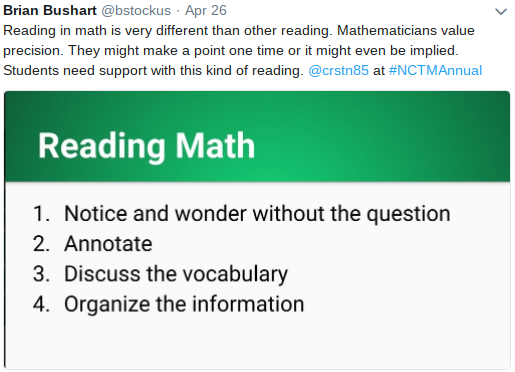
My 2017-2018 conference season has ended with a great week at the NCTM Annual Conference in D.C. This year I spoke about teaching students the language of mathematics, sporting some variation of the title "Finding the Words: Learning the Universal Language of Mathematics (Yes, We Do Write in Math Class)" and gave presentations between 45 and 90 minutes long. The longest version was at ATMNE and the most recent version was at NCTM so both of those slide decks are in the resources folder. There are many things I love about math ed twitter (and I got to share lots of them at the MTBoS booth during the conference) but at this particular moment I love that I have a record of people's reactions and highlights from my presentation. I've shared some of them below, for more detail on anything you see (references, related blog posts, all the slides) head to the resources folder. While this was probably the last time I will present this particular session (unless someone wants to hire me to do a workshop at their school), Max and I will be presenting a similar session on the Language Routines in the Illustrative Mathematics Curriculum at PCTM this summer.
November 11, 2017
Explore Math Project and DREAM
Last week was both the end of the quarter and ATMNE. I got the chance to see Tracy Zager talk (both her keynote and her workshop) and reflect on how first quarter went. Tracy's keynote was about mathematical inquiry. One method of allowing kids to ask the questions is to provide students time to play with math. Her daughter wondered why we DEAR (drop everything and read) but never DREAM (drop everything and math). After the talk, some of us who teach high school were discussing what this might look like at our level. I suggested that my version of Explore Math is one option, after all one of the columns is titled play!
This year's version of Explore Math asks students to explore something from one column per quarter and then share briefly with the class. I assigned it in all three sections of Algebra 2 as well as my honors precalculus. I've really struggled with my Algebra 2 classes and part of it is that they don't enjoy math, at all. They see every aspect of the subject as painful and it is taking every teacher tactic in my bag to convince them that math might be interesting to think about. I hoped that they would find something to grab their interest when completing this project. However, students continued to resist - I'm too shy to present, none of those 17+ options appeal to me, I don't know how to [fill in the blank]. When the first person presented on a mathematician they realized that I wasn't asking for a giant research project and almost all decided to also look up a mathematician, but there wasn't much exploration of math happening. Don't get me wrong, it was awesome to see my diverse students represented in the diverse mathematicians they chose but most didn't even look up the kind of math they studied. Maybe step one needed to be seeing that someone like them did math before they could be convinced to take another tentative step toward enjoying math? Here are the statistics from the first round:
Precalc:
61% mathematician
0% didn't do
2 recent articles, 2 recent topics, 1 unsolved problem
Alg 2 (3 sections):
64% mathematician
32% didn't do
1 brilliant.org problem
59% mathematician
36% didn't do
1 grad level math
59% mathematician
41% didn't do
I'm thankful I made this a year long project so that now for the remaining three quarters students will have to choose other categories. It seems wrong to be forcing my students to play, but after many years of learning to resent math it's going to take a strong shove toward playfulness to get them to consider it as something that they could engage with independently. (These results have a little bit to do with the project being homework, but I provided time in class on several occasions to work on this or other make up work.)
Tracy asserted that allowing kids to ask the questions is 1) intellectually honest, 2) a good way to teach and 3) important for equity and access. I have been trying harder to make the structure of class transparent to students. For example, I've shared with them the 'secret' that mathematicians are lazy! So they look for patterns to make their work easier. Most lessons involve us playing with problems to test some ideas and then generalizing our results, but when students aren't driving the questions it doesn't feel like playing. A recent lesson on matrices flowed beautifully for some students but others were so caught up in the drudgery of multiplying matrices (because integer operations require significant brainpower) that they weren't seeing the overarching ideas on their own. Turns out it's hard to recognize the significance of the identity matrix when you forget whether 5*0 is 5 or 0. So we're working our way toward 1) and 2) with some students feeling like mathematicians each day. What about 3)?
This year's version of Explore Math asks students to explore something from one column per quarter and then share briefly with the class. I assigned it in all three sections of Algebra 2 as well as my honors precalculus. I've really struggled with my Algebra 2 classes and part of it is that they don't enjoy math, at all. They see every aspect of the subject as painful and it is taking every teacher tactic in my bag to convince them that math might be interesting to think about. I hoped that they would find something to grab their interest when completing this project. However, students continued to resist - I'm too shy to present, none of those 17+ options appeal to me, I don't know how to [fill in the blank]. When the first person presented on a mathematician they realized that I wasn't asking for a giant research project and almost all decided to also look up a mathematician, but there wasn't much exploration of math happening. Don't get me wrong, it was awesome to see my diverse students represented in the diverse mathematicians they chose but most didn't even look up the kind of math they studied. Maybe step one needed to be seeing that someone like them did math before they could be convinced to take another tentative step toward enjoying math? Here are the statistics from the first round:Precalc:
61% mathematician
0% didn't do
2 recent articles, 2 recent topics, 1 unsolved problem
Alg 2 (3 sections):
64% mathematician
32% didn't do
1 brilliant.org problem
59% mathematician
36% didn't do
1 grad level math
59% mathematician
41% didn't do
I'm thankful I made this a year long project so that now for the remaining three quarters students will have to choose other categories. It seems wrong to be forcing my students to play, but after many years of learning to resent math it's going to take a strong shove toward playfulness to get them to consider it as something that they could engage with independently. (These results have a little bit to do with the project being homework, but I provided time in class on several occasions to work on this or other make up work.)
Tracy asserted that allowing kids to ask the questions is 1) intellectually honest, 2) a good way to teach and 3) important for equity and access. I have been trying harder to make the structure of class transparent to students. For example, I've shared with them the 'secret' that mathematicians are lazy! So they look for patterns to make their work easier. Most lessons involve us playing with problems to test some ideas and then generalizing our results, but when students aren't driving the questions it doesn't feel like playing. A recent lesson on matrices flowed beautifully for some students but others were so caught up in the drudgery of multiplying matrices (because integer operations require significant brainpower) that they weren't seeing the overarching ideas on their own. Turns out it's hard to recognize the significance of the identity matrix when you forget whether 5*0 is 5 or 0. So we're working our way toward 1) and 2) with some students feeling like mathematicians each day. What about 3)?
"The person who poses the question is the person who frames the debate."When Tracy said this sentence I stopped, wrote it down, tweeted it out and only partially heard her next several sentence as I grappled with this huge revelation. Politics can be decided based on who poses the question and how they frame it. How do I give my students this power? How do I make sure that my students recognize this so they can question the premise of others questions? And, honestly, how do I even consider doing any of this when I have two new preps this year? I look back on the things I did last year and regret how many of them I've let drop this year. And then I remember that I only had two preps last year and I'd taught both of them at least 3 times before. While I should cut myself some slack I'm not going to give up entirely. Up next is solving systems using matrices with technology which sounds like a good time to mix in some messy data, hopefully I can find some worthy data sets for students to play with. They can ask the questions. They can judge others' questions. We can do some aspect of this important work each class and hope that by the end of the year students see their relationship with mathematics with a bit more positivity.
October 2, 2017
Prepping System
This year I'm teaching three (substantially) different courses and my prep periods are consecutive* so at the beginning of the year I knew I'd have to find a good system for making sure I kept track of everything. It only took until the sixth day of school for me to have a close call:
Prepping has several stages. I usually complete them in this order:
1) decide what to teach
2) write/edit paper materials
3) make slides
4) copy paper materials
But when I have three different courses it's easy to get distracted with an idea for another class (or an email or a student showing up or...) and then forget what step I'm on. I had a detailed plan including handouts for precalc that day I had a close call, but nothing to project which would give students instructions and remind me of the plan!
Based on my #1TMCThing I'm using a google doc to plan. Here's the one for Algebra 2:
There are still two more steps - slides and planning. My school computer is a Mac so I'm using the Stickies program for those steps. There are 3 notes: slides, copies and to do. At the beginning of my prep I bold the whole slides note. Then as I finish a set of slides I unbold the course name and update the filename and date. Once all three sets of slides are complete I update my agenda board (which I never look at and I'm pretty sure the students don't either, but it's ready for any admin who would like to know what I'm up to). As I complete handouts I add them to my copies sticky, once I make copies I delete them from the note. The final to do sticky is general stuff like randomizing seats (weekly) or updating my google calendar with the staff meeting schedule they sent out.
I'm still overwhelmed trying to get everything done. My contained class is following the IM curriculum so I need to read the lessons, figure them out for myself and then consider modifications for my students. My algebra 2 classes are sort of following a textbook but we are supplementing a lot, luckily the teacher next door taught it last year so she has some materials. My honors precalc class is back on solid ground after we added a bonus unit, I've been teaching this class since 2012. It still takes some effort to prep though because I have a small class of quick thinking students so I have to be sure to adjust previous plans for the pace of this group. But at least with a system in place I'm pretty sure I won't be forgetting about a class anytime soon!
*We run an alternating day schedule. I have prep last block one day and first block the other day. This means that I teach all my classes in a row with no break between. I would rather have to prep algebra 2 one day and precalc the other day, but with this schedule I prep all three classes during the last block and then do all my copying during the first block the next day. I thought I'd have time to grade during the first block too but so far that hasn't happened. Maybe after the first month insanity is over?
Prepping has several stages. I usually complete them in this order:
1) decide what to teach
2) write/edit paper materials
3) make slides
4) copy paper materials
But when I have three different courses it's easy to get distracted with an idea for another class (or an email or a student showing up or...) and then forget what step I'm on. I had a detailed plan including handouts for precalc that day I had a close call, but nothing to project which would give students instructions and remind me of the plan!
Based on my #1TMCThing I'm using a google doc to plan. Here's the one for Algebra 2:
I am using this to keep track of steps one and two. Sometimes I get motivated to do some long term planning so I fill in the agenda with broad ideas of topics for each day. Then as I get to more detailed level planning I use the to do column to remind myself of what I need to find/edit/write. I have a paraprofessional in all three of my algebra 2 classes, which is awesome but new for me. I've had coteachers in the past and I know how to work with them since they also get prep periods and are expected to stay after school once a week. I'm still figuring out how to collaborate with someone when we don't have any time to chat except for 5 minutes between the two classes we teach in a row but we do take some teacher time outs in the middle of class to check in and game plan. Anyway, that column isn't getting much use yet but maybe eventually. The notes column I fill in after class in case I'm stuck teaching algebra 2 again next year (can you tell it's not my favorite course?)
There are still two more steps - slides and planning. My school computer is a Mac so I'm using the Stickies program for those steps. There are 3 notes: slides, copies and to do. At the beginning of my prep I bold the whole slides note. Then as I finish a set of slides I unbold the course name and update the filename and date. Once all three sets of slides are complete I update my agenda board (which I never look at and I'm pretty sure the students don't either, but it's ready for any admin who would like to know what I'm up to). As I complete handouts I add them to my copies sticky, once I make copies I delete them from the note. The final to do sticky is general stuff like randomizing seats (weekly) or updating my google calendar with the staff meeting schedule they sent out.I'm still overwhelmed trying to get everything done. My contained class is following the IM curriculum so I need to read the lessons, figure them out for myself and then consider modifications for my students. My algebra 2 classes are sort of following a textbook but we are supplementing a lot, luckily the teacher next door taught it last year so she has some materials. My honors precalc class is back on solid ground after we added a bonus unit, I've been teaching this class since 2012. It still takes some effort to prep though because I have a small class of quick thinking students so I have to be sure to adjust previous plans for the pace of this group. But at least with a system in place I'm pretty sure I won't be forgetting about a class anytime soon!
*We run an alternating day schedule. I have prep last block one day and first block the other day. This means that I teach all my classes in a row with no break between. I would rather have to prep algebra 2 one day and precalc the other day, but with this schedule I prep all three classes during the last block and then do all my copying during the first block the next day. I thought I'd have time to grade during the first block too but so far that hasn't happened. Maybe after the first month insanity is over?
September 12, 2017
New Classroom!
I got kicked out of the penthouse since I'm teaching mostly Algebra 2 this year (9th grade classes are on the third floor) and am back to my old wing of the school. I've now inhabited all three classrooms on my side of the hallway: 135, 134 and now 136. I've been at this school for seven years which is more than enough time to accumulate a lot of stuff. But also plenty of time to figure out how to use the standard furniture so moving was mostly a process of putting things back on their same shelf in the closet or bookcase. Here are the big decisions I made as I decided what should change or stay the same:
Student Desks
I've always done pairs in the past but I have almost all juniors and seniors this year. Plus my student teacher switched my pairs to groups last year and it worked well. So I set up (okay, Jordan set up) 7 groups of 4 for my classes of 15-25. I wanted to have groups of 3 with a seat available for me which will work for precalc (class of 15) but not for my biggest algebra 2 (class of 25). I labeled the groups with playing cards. Table 1 has desks with the ace of spades, clubs, hearts and diamonds. Last week I called on tables by number but I also look forward to asking all the hearts to share an idea or all the clubs to go get materials. I used the mini decks of cards I got from Delta (why do I have these?) so they tuck into the corner nicely.
Teacher Desk
We get a desk plus a computer table. The computer table has to be along a certain wall since that's where all the plugs are. Typically I've created a teacher corner with the two desks together either in an L or parallel with the chairs in the middle. This year my classroom is smaller and so I turned both desks to face the wall. I'm rarely sitting at my desk during class, and even when I do sit and grade while they take tests I often ended up at my big table of student desks anyway. Sadly I lost that too since this room is smaller and my classes are bigger but it is more important to me not to block the white boards than to have a teacher corner so I'll find somewhere to sit when I really need to face kids.
Bulletin Board
I loved my "extra copies" folders on the wall. I used to have algebra every day (I teach on an alternating day block but I had regular class one day and support the other day) so it took up my whole board. Now all my classes are alternating day so I can have extra copies for Algebra 2 and Precalc. After the two weeks are full I'll continue putting spare copies in an accordion folder. Fun feature - most stuff like that I labeled "Algebra" which still applies despite switching from Algebra 1 to Algebra 2. The other bulletin board is a random assortment of posters - nothing to be excited about but not blank and boring looking. I of course still have my standards of math practice up as well as my precalc graphing pictures projects.

WODB Wall
I loved the idea as soon as I saw Joel's tweet. We have limited bulletin boards in the hall so I decided to take over a section of wall instead (don't tell the fire marshal). I learned this week that the sticky notes don't stay on the cinder block with that much traffic so I'm going to track down a roll of paper to cover the wall and try again. For the first round I made it part of my algebra 2 class (we studied the graphs first, they wrote the sticky in class and then went out into the hall to stick them up). I'm curious what will happen next.
I've always done pairs in the past but I have almost all juniors and seniors this year. Plus my student teacher switched my pairs to groups last year and it worked well. So I set up (okay, Jordan set up) 7 groups of 4 for my classes of 15-25. I wanted to have groups of 3 with a seat available for me which will work for precalc (class of 15) but not for my biggest algebra 2 (class of 25). I labeled the groups with playing cards. Table 1 has desks with the ace of spades, clubs, hearts and diamonds. Last week I called on tables by number but I also look forward to asking all the hearts to share an idea or all the clubs to go get materials. I used the mini decks of cards I got from Delta (why do I have these?) so they tuck into the corner nicely.
We get a desk plus a computer table. The computer table has to be along a certain wall since that's where all the plugs are. Typically I've created a teacher corner with the two desks together either in an L or parallel with the chairs in the middle. This year my classroom is smaller and so I turned both desks to face the wall. I'm rarely sitting at my desk during class, and even when I do sit and grade while they take tests I often ended up at my big table of student desks anyway. Sadly I lost that too since this room is smaller and my classes are bigger but it is more important to me not to block the white boards than to have a teacher corner so I'll find somewhere to sit when I really need to face kids.
I loved my "extra copies" folders on the wall. I used to have algebra every day (I teach on an alternating day block but I had regular class one day and support the other day) so it took up my whole board. Now all my classes are alternating day so I can have extra copies for Algebra 2 and Precalc. After the two weeks are full I'll continue putting spare copies in an accordion folder. Fun feature - most stuff like that I labeled "Algebra" which still applies despite switching from Algebra 1 to Algebra 2. The other bulletin board is a random assortment of posters - nothing to be excited about but not blank and boring looking. I of course still have my standards of math practice up as well as my precalc graphing pictures projects.
WODB Wall
I loved the idea as soon as I saw Joel's tweet. We have limited bulletin boards in the hall so I decided to take over a section of wall instead (don't tell the fire marshal). I learned this week that the sticky notes don't stay on the cinder block with that much traffic so I'm going to track down a roll of paper to cover the wall and try again. For the first round I made it part of my algebra 2 class (we studied the graphs first, they wrote the sticky in class and then went out into the hall to stick them up). I'm curious what will happen next.
September 9, 2017
Start of Year: Algebra 2
The last time I taught Algebra 2 was in 2010-2011. It was my first year at this school and I had a class of kids who were not excited about math - some had only managed to get credit for Algebra 1 by attending 3 weeks of summer school that everyone passes. I wrote at the end of my post on student reflections on the course: Thank goodness I'm not teaching Algebra 2 again! And I managed to avoid it for many years. The thing I hated about teaching Algebra 2 was it felt like Algebra 1 all over again, so when administration asked if I would move to Algebra 2 this year I said yes on one condition - that I could skip the review units. Because if kids have been learning about lines since 7th grade, why would I teach them yet another unit on lines? You say they don't get it? Who cares! There is so much math in the world, I would hate math too if all we ever did was repeat a mantra of y=mx+b, rise over run for five years in a row (linear review has infiltrated geometry too since kids take a state test on algebra and geometry that year). One, I don't particularly care if they can write the equation of a line from memory. Two, they're more likely to realize why lines are special if we do some stuff other than lines and then compare. But really, there's so much cool math we never get to, let's just move on! So I talked to a coworker who has taught Algebra 2 for the last several years and then my co-teacher (who also co-taught with that same coworker) and I sat down and made a plan together. We have a timeline for units that we will eventually add standards to as we get ready for the transition to standards based grading next year (this is the reason I got moved - they took two of us from the Algebra 1 SBG planning team and moved us onto other teams to repeat the process).
Aside from the essential content of Algebra 2 I have a few goals:
1) Expand students' idea of what math and mathematicians are by doing the Explore Math project. Instead of waiting until the end of the year I plan to have students complete one column per quarter which means frequent short presentations throughout the year.
2) Provide space for talking about big ideas, current events and equity issues. I'm not planning to do weekly homework the same way I did last year (I don't have lessons I like for this course, I can't be writing lessons and deep weekly assignments) but I hope to incorporate the same ideas in my class assignments. In fact, already started on day one! (below)
3) Push students to do more writing. I've always asked students to reflect at the end of class but with younger kids and a large number of them ELL or students with disabilities I asked for two sentences. I provided a third of a page per day this year, I'm curious if that will be enough or if I'll need to specify my expectations (and possibly modify for the smaller number of ELLs and students with disabilities). Inspired by Jonathan I'll be asking for longer explanations on assessments as well. Last year's weekly homework meant students regularly wrote persuasive paragraphs. This year I hope to continue to encourage debate while including some more expository writing.
4) Employ the strategies of visibly random grouping and vertical nonpermanent surfaces to improve students' confidence sharing their ideas with others. Marian recently tweeted about helping students find their inner rebel, that's definitely a factor in my goal of confidence boosting!
First lesson:

We are starting the year with piecewise functions (a tiny bit of linear review with a big focus on domain, range and fluency interpreting graphs). I told them the story of the weather caused by Hurricane Harvey in one location and asked them to graph stream elevation at that location. Then we talked about how data is more complex than the over simplification of our graphs - it could be raining at the same time the stream is draining and every time one of those rates changes the graph reflects it. Reality is way more bumpy than my grossly over simplified story. Next I showed them a graph of stream elevation at a different location and asked them to tell me the story of the weather there. Of course a verbal description isn't enough, so we also described numerically (domain/range) and with equations. After discussing two graphs in depth I projected them with two more, in a WODB format. Kids decided which one didn't belong, I emphasized the multiple right answers and they wrote their reasons on sticky notes to add to my display in the hallway. I was interested to find that some students asked for vocabulary "what's it called again when it goes over the red line?" to put their explanation in context. Throughout this conversation I shared stories (here's a timelapse my friend took, he didn't get flooded. See how this stream still wasn't drained on the 31st? The highways weren't drained until yesterday!) and invited questions. Yes, I picked this context on purpose, I want to talk about big things happening in the world in this class. We didn't specifically get into ideas of equity but I would like to think about how I could include something like this cost analysis soon (maybe it will fit in systems, that's our next unit). Slides here.
Since we had almost a full block on the very first day there was still some time left for students to get started on a problem set. I sent them to the boards to analyze other piecewise situations (for three problems I gave them the context and for one I gave them the graph).* You may notice I haven't mentioned the syllabus yet, I gave it out at the very end of class and told the kids to read it for homework but we would go over each aspect of class as it came up rather than me explaining it that day just for them to forget. And then I explained the journaling aspect of class and had them reflect on day one!
Second class plan:
Most students didn't finish their first problem of the problem set so we'll need to spend a bunch more time on that. Unsurprisingly they didn't all remember how to write the equation of a line so I'll do a very mini review of the various forms available to them and then send them back to their boards and groups to finish. I think I'll have them do Sara's 100 numbers activity to talk about how to be good group members first. If groups finish the problem set with time to spare then they can play on waterline. I'm saving function carnival for the next class - we'll complete it, do the follow up activity and then they'll have to write the piecewise equation for bumper cars and explain it for homework.
*Amazingly my evaluating administrator stopped by while one class was working on these problems. Teachers with tenure (like me) are supposed to be on a two year evaluation cycle but at the end of last year I got placed on a one year cycle. The concern was my classroom management and my evaluator asked why I didn't have my algebra 1 students up working at the boards the same way I used to with my geometry students. The reasons are complicated (as most aspects of teaching are!) but the point is that he wanted kids up at the boards at the end of last year and he saw my kids up at the boards the very first week this year. He was excited and I feel significantly less dread about the evaluation cycle this year!
Aside from the essential content of Algebra 2 I have a few goals:
1) Expand students' idea of what math and mathematicians are by doing the Explore Math project. Instead of waiting until the end of the year I plan to have students complete one column per quarter which means frequent short presentations throughout the year.
2) Provide space for talking about big ideas, current events and equity issues. I'm not planning to do weekly homework the same way I did last year (I don't have lessons I like for this course, I can't be writing lessons and deep weekly assignments) but I hope to incorporate the same ideas in my class assignments. In fact, already started on day one! (below)
3) Push students to do more writing. I've always asked students to reflect at the end of class but with younger kids and a large number of them ELL or students with disabilities I asked for two sentences. I provided a third of a page per day this year, I'm curious if that will be enough or if I'll need to specify my expectations (and possibly modify for the smaller number of ELLs and students with disabilities). Inspired by Jonathan I'll be asking for longer explanations on assessments as well. Last year's weekly homework meant students regularly wrote persuasive paragraphs. This year I hope to continue to encourage debate while including some more expository writing.
4) Employ the strategies of visibly random grouping and vertical nonpermanent surfaces to improve students' confidence sharing their ideas with others. Marian recently tweeted about helping students find their inner rebel, that's definitely a factor in my goal of confidence boosting!
First lesson:
We are starting the year with piecewise functions (a tiny bit of linear review with a big focus on domain, range and fluency interpreting graphs). I told them the story of the weather caused by Hurricane Harvey in one location and asked them to graph stream elevation at that location. Then we talked about how data is more complex than the over simplification of our graphs - it could be raining at the same time the stream is draining and every time one of those rates changes the graph reflects it. Reality is way more bumpy than my grossly over simplified story. Next I showed them a graph of stream elevation at a different location and asked them to tell me the story of the weather there. Of course a verbal description isn't enough, so we also described numerically (domain/range) and with equations. After discussing two graphs in depth I projected them with two more, in a WODB format. Kids decided which one didn't belong, I emphasized the multiple right answers and they wrote their reasons on sticky notes to add to my display in the hallway. I was interested to find that some students asked for vocabulary "what's it called again when it goes over the red line?" to put their explanation in context. Throughout this conversation I shared stories (here's a timelapse my friend took, he didn't get flooded. See how this stream still wasn't drained on the 31st? The highways weren't drained until yesterday!) and invited questions. Yes, I picked this context on purpose, I want to talk about big things happening in the world in this class. We didn't specifically get into ideas of equity but I would like to think about how I could include something like this cost analysis soon (maybe it will fit in systems, that's our next unit). Slides here.
Since we had almost a full block on the very first day there was still some time left for students to get started on a problem set. I sent them to the boards to analyze other piecewise situations (for three problems I gave them the context and for one I gave them the graph).* You may notice I haven't mentioned the syllabus yet, I gave it out at the very end of class and told the kids to read it for homework but we would go over each aspect of class as it came up rather than me explaining it that day just for them to forget. And then I explained the journaling aspect of class and had them reflect on day one!
Second class plan:
Most students didn't finish their first problem of the problem set so we'll need to spend a bunch more time on that. Unsurprisingly they didn't all remember how to write the equation of a line so I'll do a very mini review of the various forms available to them and then send them back to their boards and groups to finish. I think I'll have them do Sara's 100 numbers activity to talk about how to be good group members first. If groups finish the problem set with time to spare then they can play on waterline. I'm saving function carnival for the next class - we'll complete it, do the follow up activity and then they'll have to write the piecewise equation for bumper cars and explain it for homework.
*Amazingly my evaluating administrator stopped by while one class was working on these problems. Teachers with tenure (like me) are supposed to be on a two year evaluation cycle but at the end of last year I got placed on a one year cycle. The concern was my classroom management and my evaluator asked why I didn't have my algebra 1 students up working at the boards the same way I used to with my geometry students. The reasons are complicated (as most aspects of teaching are!) but the point is that he wanted kids up at the boards at the end of last year and he saw my kids up at the boards the very first week this year. He was excited and I feel significantly less dread about the evaluation cycle this year!
June 25, 2017
How Many?
I teach an Algebra 1 class that meets every day (our block schedule means classes usually only meet every other day) so I needed twice as many openers for that class. The reason they meet every day is due to substantial learning disabilities, and the majority of the class has a language based learning disability on top of challenges with math. Based on all of this I decided to start each of their bonus classes with the simple question: "How many?" followed by an image. I started with the idea of doing number talks but was quickly captivated by Christopher's simple question (blog post, book coming soon?!) The best part of this activity was the blend of math and language. Wait, maybe the best part was the low entry. Or perhaps it was the opportunity to share all sorts of cool things that helped build foundational skills (ex: subitizing and multiplicative thinking) that these students struggled with? Okay there were too many best parts!
The first week kids declared this baby work. They were in high school, they didn't need to practice counting! They definitely said this because they didn't see the value, but also because it was hard. Many days I would see kids standing at the board counting individual items. My co-teacher and I encouraged students to come up with strategies so they didn't have to count every item. We shared strategies such as counting rows and columns, looking for repetition and grouping nice numbers. Here's one we did in September:

First kids counted each item (green numbers). Then kids recognized that two halves made a whole and so they counted the number of wholes (red numbers over the image). I remember discussing "what do we call this?" since it wasn't an object we recognized (lime? grape fruit?) but it was important to differentiate between the 8 and the 16. We decided it was definitely a fruit and so we were able to apply that word - language in math class! Then someone (probably me since it was the beginning of the year but not necessarily) pointed out that there were four rows and four columns. One of my students would consistently yell out "array!" when we were discussing rows and columns, I love that he had that word in his vocabulary. We connected counting pieces one by one to multiplying rows by columns. Importantly, I did not belittle anyone for counting one by one. I was happy to hear any and all quantities and strategies. Early in the year I did not get as many contributions, but as students felt more comfortable they stopped complaining and started getting creative.
Just last month we did another image of sliced fruit:

The list on the right is the initial brainstorm (the class is down to six students so one idea from each of them). Then we wanted to get more specific - how big are those two slices? It was an incredibly happy coincidence that we were practicing exponential functions that day, I couldn't have planned that better if I tried! If I hadn't been so focused on the fractions I'm sure they would have added "two seeds" and "one brown background" to their list. Naming the background became the default if someone had already said what they wanted to share. I love that this activity encouraged them to think creatively and pay attention to details.
One day in December we had a particularly vocabulary-rich discussion:

Not everyone agreed when we got the first round of ideas, but I wrote them all down anyway. After gathering ideas without comment, we began our discussion. In addition to a discussion of the differences between a square and a rhombus, someone also coined the term semi-octagon! I was so excited to see kids who generally lack confidence in math and language to be creating their own math vocabulary. Also? Their definition of diamond is the basic pentagon tile because it looks like a cut gemstone diamond. No one called the rotated square a diamond!
I really enjoyed doing this activity every other day. Students had three minutes from the time the bell rang to record everything they noticed. I asked each student to contribute one answer to the question "How many?" before I allowed any students to contribute additional quantities or comment on the other answers. I had fun choosing photos from this number talk site, things I'd seen on twitter (#howmany or #unitchat) and even photos I took myself. All the images I used this year are in a dropbox folder. I look forward to playing again next year. Perhaps I will encourage them to bring in photos or we will go on a photo scavenger hunt someday together!
The first week kids declared this baby work. They were in high school, they didn't need to practice counting! They definitely said this because they didn't see the value, but also because it was hard. Many days I would see kids standing at the board counting individual items. My co-teacher and I encouraged students to come up with strategies so they didn't have to count every item. We shared strategies such as counting rows and columns, looking for repetition and grouping nice numbers. Here's one we did in September:
First kids counted each item (green numbers). Then kids recognized that two halves made a whole and so they counted the number of wholes (red numbers over the image). I remember discussing "what do we call this?" since it wasn't an object we recognized (lime? grape fruit?) but it was important to differentiate between the 8 and the 16. We decided it was definitely a fruit and so we were able to apply that word - language in math class! Then someone (probably me since it was the beginning of the year but not necessarily) pointed out that there were four rows and four columns. One of my students would consistently yell out "array!" when we were discussing rows and columns, I love that he had that word in his vocabulary. We connected counting pieces one by one to multiplying rows by columns. Importantly, I did not belittle anyone for counting one by one. I was happy to hear any and all quantities and strategies. Early in the year I did not get as many contributions, but as students felt more comfortable they stopped complaining and started getting creative.
Just last month we did another image of sliced fruit:
The list on the right is the initial brainstorm (the class is down to six students so one idea from each of them). Then we wanted to get more specific - how big are those two slices? It was an incredibly happy coincidence that we were practicing exponential functions that day, I couldn't have planned that better if I tried! If I hadn't been so focused on the fractions I'm sure they would have added "two seeds" and "one brown background" to their list. Naming the background became the default if someone had already said what they wanted to share. I love that this activity encouraged them to think creatively and pay attention to details.
One day in December we had a particularly vocabulary-rich discussion:
Not everyone agreed when we got the first round of ideas, but I wrote them all down anyway. After gathering ideas without comment, we began our discussion. In addition to a discussion of the differences between a square and a rhombus, someone also coined the term semi-octagon! I was so excited to see kids who generally lack confidence in math and language to be creating their own math vocabulary. Also? Their definition of diamond is the basic pentagon tile because it looks like a cut gemstone diamond. No one called the rotated square a diamond!
I really enjoyed doing this activity every other day. Students had three minutes from the time the bell rang to record everything they noticed. I asked each student to contribute one answer to the question "How many?" before I allowed any students to contribute additional quantities or comment on the other answers. I had fun choosing photos from this number talk site, things I'd seen on twitter (#howmany or #unitchat) and even photos I took myself. All the images I used this year are in a dropbox folder. I look forward to playing again next year. Perhaps I will encourage them to bring in photos or we will go on a photo scavenger hunt someday together!
Subscribe to:
Posts (Atom)