Showing posts with label SwD. Show all posts

April 29, 2018

Finding the Words: Learning the Language of Mathematics

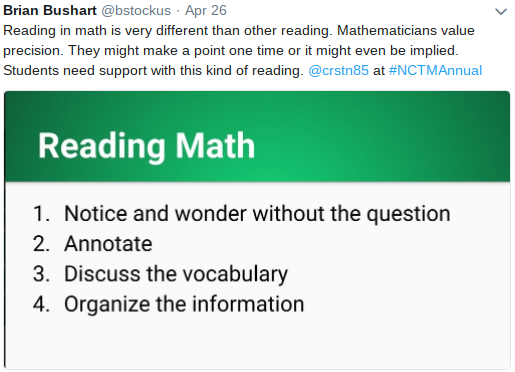
My 2017-2018 conference season has ended with a great week at the NCTM Annual Conference in D.C. This year I spoke about teaching students the language of mathematics, sporting some variation of the title "Finding the Words: Learning the Universal Language of Mathematics (Yes, We Do Write in Math Class)" and gave presentations between 45 and 90 minutes long. The longest version was at ATMNE and the most recent version was at NCTM so both of those slide decks are in the resources folder. There are many things I love about math ed twitter (and I got to share lots of them at the MTBoS booth during the conference) but at this particular moment I love that I have a record of people's reactions and highlights from my presentation. I've shared some of them below, for more detail on anything you see (references, related blog posts, all the slides) head to the resources folder. While this was probably the last time I will present this particular session (unless someone wants to hire me to do a workshop at their school), Max and I will be presenting a similar session on the Language Routines in the Illustrative Mathematics Curriculum at PCTM this summer.


September 30, 2017

Using IM 8th Grade with Students with Disabilities

Side note about the title: I wish my class had a more recognizable name so I could title this post "Learning Skills, One Month In" but I forget that "Learning Skills" only means something to a handful of teachers at my school. It's what we used to call the level above Life Skills. This year my schedule just says "Math" as the course name, so helpful right?

A few weeks ago I wrote about how I was trying to figure out what to teach my contained special ed class. I decided to try some activities and then determine if the 8th grade IM curriculum would be a good fit. The class rocked my word problems with tape diagrams/bar models handout. I was impressed with their language skills; this activity is great for testing if students can make sense of problems and my group absolutely can! They needed counting objects for most problems but they were able to take the concrete representations and turn them into number sentences (no one used variable equations but that was just fine) and word sentences. Buoyed by this success we decided to move into the IM curriculum.

We've continued to play how many every day. It's interesting how some students are still resisting. They ask "Again??" when they walk in but even on days where I plan a short discussion they bring up interesting ideas and want to share all the things they notice once we get started! I'm enjoying having an organized folder of images. Right now we are working on arrays. Not every student is using multiplication as a strategy reliably but we write down a row x column = total equation each day. We are also working on one to one correspondence (I think? Remember, I'm a high school teacher by training so this is non-native vocab). We talk about how to figure out how many stems there are if we already counted the number of peppers (the same) or how many eyes there are if we already counted the number of stuffed animals (double - this was surprisingly challenging for them to grasp!).

The first lesson of 8th grade IM started with the same response. I think it stems from a feeling of "this seems like it should be easy but I don't feel confident." So I didn't get many kids to dance with me but we got enough practice that we built a list of transformation vocab that was sufficient to define terms the next class. We tried to do the card sort from lesson 2 as a desmos activity but that was too abstract for my concrete thinkers. So I opted to replace the next couple IM lessons which relied on geogebra with paper handouts from my days teaching geometry. We did a variety of transformation practice activities starting with moving (and tracing) physical shapes and graduating to using wax paper for reflections and rotations. Some students had a much easier time seeing the transformations than others, but all felt successful using the wax paper. After two great classes of following transformation instructions I posed the question "Does order matter?" and asked students to generate some transformations of their own to test the hypothesis. This was far too abstract and I stopped them, apologized mid class, thanked Desmos for their amazing timing and opened up transformation golf to demonstrate completing the same transformations in different orders. Then they were eager to play!

Last class we returned to the IM activities to do an info gap. It was excellent and the structured conversation was perfect for my students to practice vocabulary. Then I let them play transformation golf and was surprised to find they had a hard time understanding how to use the arrows (I automatically put the endpoint on the purple figure I was trying to transform, this wasn't intuitive for my students). Even though they struggled some with the interface they were successful at completing several tasks and were eager to have me play their various solutions so the class could see how many different ways there were to solve a problem!

So, where does that leave us? I've learned that concrete representations are going to be essential for this group. I'm not going to be able to use the IM curriculum as it stands with my students but hopefully I can use most of the ideas and activities just supplementing with physical models wherever possible. I think I'm going to need to spend some time soon looking at a year long calendar and the list of topics. Since I'm getting through one lesson per block and we only have class every other day I'm going to have to cut a lot. It would be good to have some idea of how that will work since the Pythagorean theorem is at the end and its definitely worth spending time on with this group. A task for tomorrow perhaps. It would be cool if the OUR site had a built in planning tool, especially because it could link to each lesson (4 clicks isn't hard, but it's still 3 more clicks than ideal).

September 10, 2017

Learning Skills

One of my classes is for students with significant learning disabilities. There are eight students, two in each grade level. They are beyond basic math but not yet ready for Algebra 1, which is a broad range! Only one has passed state test so it seems reasonable to let that guide my choice of topics (not to teach to the test, but given the entirety of mathematics to choose from I need something to help narrow my focus). The standards still span from 5th to 10th grade in four very broad categories. I'm certainly not going to teach a purely test prep class but I also can't be developing a complete curriculum. The last time I taught this course (several years ago) I pulled from a few sources but it was still quite haphazard. This year I want to pick one curriculum and follow it. Anything I use will still need careful modification to fit a class of eight with unique learning needs but I'd much rather have something to start with than to be constantly searching my files for new ideas. I liked Bridge to Algebra and Transition to Algebra but found both to be language heavy for students with disabilities and ELL's (a couple students fall in both categories).

We played four fours on the first day. Everyone has heard of the order of operations but relied on calculators to do computations. [Side note: I need to get a better set of calculators, I currently have the ones where you can't see what you typed as soon as you hit the next button, I'll ask around and see who I can trade with.] For a bit of continuity I plan to do some order of operations work tomorrow too and then see what happens if I offer some word problems with tape diagrams. If that handout goes okay I'm thinking about trying the 8th grade IM curriculum. I will check with my co-teacher, their IEP goals and the program head to see if 8th grade is a reasonable starting point.

We'll play How Many as our daily opener and find some other games for the end of class. This will allow us to focus on skills they need from before 8th grade and break up our 90 minute blocks.

I love when blogging helps me to make a plan. I feel much better about this class now. Of course, this all depends on a lot of factors working out, but at least I have a plan A to try! If you're using 8th grade IM with students with disabilities and it works out for us I'd love to find a way to share modifications.

June 25, 2017

How Many?

I teach an Algebra 1 class that meets every day (our block schedule means classes usually only meet every other day) so I needed twice as many openers for that class. The reason they meet every day is due to substantial learning disabilities, and the majority of the class has a language based learning disability on top of challenges with math. Based on all of this I decided to start each of their bonus classes with the simple question: "How many?" followed by an image. I started with the idea of doing number talks but was quickly captivated by Christopher's simple question (blog post, book coming soon?!) The best part of this activity was the blend of math and language. Wait, maybe the best part was the low entry. Or perhaps it was the opportunity to share all sorts of cool things that helped build foundational skills (ex: subitizing and multiplicative thinking) that these students struggled with? Okay there were too many best parts!

The first week kids declared this baby work. They were in high school, they didn't need to practice counting! They definitely said this because they didn't see the value, but also because it was hard. Many days I would see kids standing at the board counting individual items. My co-teacher and I encouraged students to come up with strategies so they didn't have to count every item. We shared strategies such as counting rows and columns, looking for repetition and grouping nice numbers. Here's one we did in September:


First kids counted each item (green numbers). Then kids recognized that two halves made a whole and so they counted the number of wholes (red numbers over the image). I remember discussing "what do we call this?" since it wasn't an object we recognized (lime? grape fruit?) but it was important to differentiate between the 8 and the 16. We decided it was definitely a fruit and so we were able to apply that word - language in math class! Then someone (probably me since it was the beginning of the year but not necessarily) pointed out that there were four rows and four columns. One of my students would consistently yell out "array!" when we were discussing rows and columns, I love that he had that word in his vocabulary. We connected counting pieces one by one to multiplying rows by columns. Importantly, I did not belittle anyone for counting one by one. I was happy to hear any and all quantities and strategies. Early in the year I did not get as many contributions, but as students felt more comfortable they stopped complaining and started getting creative.

Just last month we did another image of sliced fruit:

The list on the right is the initial brainstorm (the class is down to six students so one idea from each of them). Then we wanted to get more specific - how big are those two slices? It was an incredibly happy coincidence that we were practicing exponential functions that day, I couldn't have planned that better if I tried! If I hadn't been so focused on the fractions I'm sure they would have added "two seeds" and "one brown background" to their list. Naming the background became the default if someone had already said what they wanted to share. I love that this activity encouraged them to think creatively and pay attention to details.

One day in December we had a particularly vocabulary-rich discussion:

Not everyone agreed when we got the first round of ideas, but I wrote them all down anyway. After gathering ideas without comment, we began our discussion. In addition to a discussion of the differences between a square and a rhombus, someone also coined the term semi-octagon! I was so excited to see kids who generally lack confidence in math and language to be creating their own math vocabulary. Also? Their definition of diamond is the basic pentagon tile because it looks like a cut gemstone diamond. No one called the rotated square a diamond!

I really enjoyed doing this activity every other day. Students had three minutes from the time the bell rang to record everything they noticed. I asked each student to contribute one answer to the question "How many?" before I allowed any students to contribute additional quantities or comment on the other answers. I had fun choosing photos from this number talk site, things I'd seen on twitter (#howmany or #unitchat) and even photos I took myself. All the images I used this year are in a dropbox folder. I look forward to playing again next year. Perhaps I will encourage them to bring in photos or we will go on a photo scavenger hunt someday together!