We are working on sequences and series in PreCalc (and I'm using Sam's stuff which is awesome, but this post isn't about content, I promise to share how I adapted it later). Last class I had kids exploring visual patterns and then for homework they were supposed to find general form equations for a bunch of numerical sequences. I knew that students would have varying degrees of familiarity with the sequences included (from linear to perfect squares to factorials to alternating 1 and -1) so the homework instructions specifically said "if you cannot come up with an equation, describe the pattern." As a warm up today I asked students to list "sequences that are important to recognize" and we came up with a really useful table (name, first five terms, nth term) based on all the patterns they had recognized in the homework or looked up in the back of the book. After we were done (and I'd given my spiel on how important this was to record and keep since it would help them to Look For and Make Use of Structure), a student commented "You know, this list would have been really useful to have before we did the homework." I immediately felt myself getting angry. At the time I couldn't pinpoint exactly why this comment made me so angry, but I tried to keep my cool and explain once again that the homework had been to recognize patterns and figure things out, I certainly didn't expect them to know all the formulas already. She continued to argue, my blood continued to boil, I recommended that she come after school if she didn't know how to analyze patterns and the class all jumped in to take my side. I wish it hadn't come to the point of everyone vs. this student. I wish that I had acknowledged her frustration and ended the conversation, talking to her privately later if she wanted to. But most of all, I realize now, I wish that she trusted herself to think. The comment made me so frustrated because it's the very last day in May and I have yet to convince this child that she can figure things out for herself. I'm running out of time to reach her, and this thought is devastating.
I know I should be happy with how many students I have reached. And there are many. And I know that I've made progress with this student; even if I haven't made her believe in her own abilities, I am paving the way for someone else to do it. Life long learning and all that. But right now I'm just upset that the circumstances all to often lead to high schoolers who won't play with math, who think they need to be taught before they can do anything, who demand a method because they honestly don't believe that they are capable of coming up with one on their own. In my department we have an essential question that runs through all of our courses: "Is mathematics invented or discovered?" If students leave with nothing else, I hope that they leave with the understanding that mathematics isn't arbitrary, it's not something someone made up to torture them with and the rules should make sense. And, if all those things are true, math is something they can experiment with and make their own discoveries. Because, dear child, you can think.
May 31, 2013


May 28, 2013
Just Another Day
It is now 7 pm and I have been working for 12 hours straight.
May 28, 2013
7:00 am: leave for school, run through lesson plans as I drive
7:05 am: arrive at school and rush to get papers printed (progress reports I updated by spending half my weekend grading) and notebook files ready (I don't have the program on my home computer that cooperates with my SMART board)
7:24 am: start teaching
11:58 am: stop teaching (yup, that's 4 hours and 34 minutes without a break). Lunch.
12:25 pm: check email, drop something off in the main office, return to my room to find students seeking extra help. Try to get grading and prep done while simultaneously assisting students.
2:02 pm: school ends, kids show up for extra help. Bounce between students and look longingly at my computer because I have an idea for an upcoming lesson I don't want to lose
3:00 pm: last student leaves. Type up my idea and reclaim my desk.
3:45 pm: try to print papers for tomorrow and learn that someone turned off the copier. I'm still here! Walk down to the copier and turn it on, leave to go to the bathroom while it warms up, make copies
3:57 pm: leave school, try to call doctor's office before they close, busy signal! Head to Staples to buy ink for my printer (because all the school printers are out of ink I bought a printer for my classroom) and to the grocery store to pick up a few things for myself plus candy because my stock is depleted and sometimes kids deserve a treat after school.
5:00 pm: play with ideas on inscribing and circumscribing circles, debate paper and pencil constructions vs. geogebratube vs. geogebra constructions. Chat with coworker about advisory tomorrow, the total lack of advance notice and what on earth we're going to do with these kids for an hour.
7:00 pm: realize it's 7 pm and I've been working for 12 hours. Wonder where the time went. Write it all out just to see. Post it for no real reason I can think of other than I wanted to see it written out so now you get to see it too? I'm going to try to stop working now. Maybe.
May 28, 2013
7:00 am: leave for school, run through lesson plans as I drive
7:05 am: arrive at school and rush to get papers printed (progress reports I updated by spending half my weekend grading) and notebook files ready (I don't have the program on my home computer that cooperates with my SMART board)
7:24 am: start teaching
11:58 am: stop teaching (yup, that's 4 hours and 34 minutes without a break). Lunch.
12:25 pm: check email, drop something off in the main office, return to my room to find students seeking extra help. Try to get grading and prep done while simultaneously assisting students.
2:02 pm: school ends, kids show up for extra help. Bounce between students and look longingly at my computer because I have an idea for an upcoming lesson I don't want to lose
3:00 pm: last student leaves. Type up my idea and reclaim my desk.
3:45 pm: try to print papers for tomorrow and learn that someone turned off the copier. I'm still here! Walk down to the copier and turn it on, leave to go to the bathroom while it warms up, make copies
3:57 pm: leave school, try to call doctor's office before they close, busy signal! Head to Staples to buy ink for my printer (because all the school printers are out of ink I bought a printer for my classroom) and to the grocery store to pick up a few things for myself plus candy because my stock is depleted and sometimes kids deserve a treat after school.
5:00 pm: play with ideas on inscribing and circumscribing circles, debate paper and pencil constructions vs. geogebratube vs. geogebra constructions. Chat with coworker about advisory tomorrow, the total lack of advance notice and what on earth we're going to do with these kids for an hour.
7:00 pm: realize it's 7 pm and I've been working for 12 hours. Wonder where the time went. Write it all out just to see. Post it for no real reason I can think of other than I wanted to see it written out so now you get to see it too? I'm going to try to stop working now. Maybe.
May 26, 2013
Matrix Mess
One of the challenges of PreCalculus is making it seem like a cohesive course rather than a list of skills to review and master. My theme lately has been "solving problems efficiently." Students have learned a variety of methods to solve, for example, systems of equations. My goal is for them to master each method and know how to choose amongst them. Since we had just finished the unit on conics, we solved systems of second degree equations (smoother transition plus a more challenging set of problems than the ones they'd seen in both Algebra 1 and 2). That all went fine and students worked on elimination, substitution and graphing. However, I also wanted to review matrices and so I upped the ante to three variables (but returned to first degree equations). The problem was, I didn't want to take the time to properly review matrices, I just wanted to remind students that they're useful when solving systems. This obviously backfired.


Thoughts and further suggestions would be much appreciated.
After a rough week of allergy haze, it was already after school on the day before I needed to give this lesson and I still didn't have a plan. I had a vague idea of what I wanted to happen but couldn't even put it into words when explaining my thoughts to a coworker. Despite my incoherence she helped me out by putting together this worksheet (which she fully expected me to edit but I was too exhausted to do much):
I also put this problem on the board:
And had this diagram ready to show students who needed help remembering how to multiply:

You already know this is going to go badly because the material is split into three places and is dependent on me showing up with a diagram at the right moment. Students were totally baffled why they were multiplying matrices. They didn't understand that the calculator would be taking the inverse (some tried to multiply the matrix by -1). They didn't read the instructions all the way through and were calling me over to help with the calculator.
My attempt at a rewrite:
Thoughts and further suggestions would be much appreciated.
CCSS Pathways
A conversation on twitter prompted Michael Fenton to request information on how different schools are tracking students now and how it will change as we adopt the CCSS. If more people blog their response (rather than writing a comment) I'll add this topic to the #matheme page.
Sequence in Past Years:
Honors: 8th grade algebra 1, 9th grade geometry, 10th grade algebra 2, 11th grade PreCalc, 12th grade AP Calc. Some double up with AP stat 10th or 11th grade or do stat rather than calc 12th grade
Sequence in Past Years:
Honors: 8th grade algebra 1, 9th grade geometry, 10th grade algebra 2, 11th grade PreCalc, 12th grade AP Calc. Some double up with AP stat 10th or 11th grade or do stat rather than calc 12th grade
Regular: 9th grade algebra 1, 10th grade geometry, 11th grade algebra 2, 12th grade PreCalc or Stat or Contemporary Math
There is an opportunity to jump from regular to honors track by doubling Algebra 2 and geometry in 10th grade. Every course has different levels as well, so students could take Honors Algebra 1 in high school and Honors Algebra 2, for example, is mixed grade.
This year (partly due to ANet testing) all 8th graders followed the 8th grade standards this year. However, some parents are still convinced their kids are ready for geometry without having taken Algebra 1. So, to prevent losing kids to private schools, we are offering a new semester long Algebra 1 course covering only the topics not seen in 8th grade standards.
Honors: 9th grade full year geometry and 1 semester algebra 1, 10th grade algebra 2, 11th grade PreCalc, 12th grade ap calc
Regular track is the same, still the opportunity to jump from regular to honors by doubling up on geometry and algebra 2
We specifically chose not to combine algebra and geometry or do a semester of each because our geometry courses emphasize reasoning in a different way than all of the other courses and it's important for students to study all kinds of math. Any course created with the intention of "getting kids to calculus" is going to emphasize algebra over geometry and we don't want to take that risk. Just as we leave the probability and statistics standards to the end of every course and frequently don't reach them, geometry would fall to the wayside in the same way. That said, I'm all for integrated courses when the whole path is integrated, that isn't something we are looking at right now though.
There is also a remedial path where students start high school with a double block of algebra 1 to get them caught up. They continue to follow the regular track from there. In the past students who fail algebra 1 take a repeater algebra 1 course (separate from the 9th grade course). Next year we are opening a math lab and we're going to try splitting those students who failed between 8 blocks of the lab and creating an individualized program for each student based on their strengths and weaknesses. If you have any ideas on how to run a math lab we are looking for advice. The vague plan is to have a few students assigned to each section (the ones who failed algebra 1) and then send other students in as needed for remediation.
May 19, 2013
Conics Unit: Photo Project
I'll let one of my students tell you the story of this project:
AP Exams interrupted class for two days so I knew I needed something that would be beneficial for the students in class, but that the students in exams could do on their own. A quick search led me to this awesome project. Monday we spent some time wandering the school taking pictures. Some days it's annoying that everyone in class has their phone out, but that day I appreciated just how easy it was to say "okay class, photo scavenger hunt!" and they all had cameras at the ready. The gym was the best place because the basketball court is covered with conic sections. Students couldn't find any hyperbolas, so they grabbed some ropes and tried to make one. An unintended bonus of this project was the discussions that came up about curvature. Telling the difference between a parabola and a semi-circle was a challenge and many students held the misconception that they could make a parabola fit a semi-circle. Students were also upset if their circular object came out elliptical because of the angle they took the photograph. All great concepts to work out.


On Monday I gave everyone handouts and the week before students made dichotomous keys which told them how to write equations, but at the beginning of class on Friday everyone started with just their computers. They whined and complained. They demanded help with tiny things. They could not believe I would make them use decimals rather than round to the nearest whole number. They basically threw teenage temper tantrums. I was more helpful than normal since there were only seven students but I finally realized what I was doing, sat down and refused to help anyone until they had the relevant papers on their desk. One by one, students learned to work in GeoGebra and realized the task was just like what we were doing the previous class. Soon, everyone was focused and quiet. One student requested music and we turned on the bachata pandora station. They helped each other and most had finished the project by the end of class, after admitting it was a fun assignment. The next class went much smoother thanks to my realization that being less helpful was the key to everyone’s sanity.
Other things to note:

It all started on a Monday morning around 9:05 a.m when the class decided to go for a walk in and around the school. That’s when I felt I was surrounded by conics, but not just ellipse there were also parabolas and hyperbola. I felt a bit overwhelmed because I had never seen so many conics on a single walk in my whole life. I was down stairs in the field house when I saw the perfect conic. I cried at the first sight because it was so beautiful. There the conic was on the side of a vending machine; it was a Pepsi symbol was a circle. Once this breath-taking picture was captured I immediately sent it to [student email]. Next I open this amazing program called Geogebra. I pasted the picture and made it transparent so I could see the graph in order to plot point on the circle. Next after I plotted my points I figured out the key information to making the equation for the circle. I founded the center was (0,0), and the radius was perfect two which worked out perfectly for me. Once I had the center and the radius of the circle I was ready to form an equation for this conic. I Enter the equation (X^2/4)+(Y^2/4)=1 and turns out I was right on the money, which made me feel like I actually understood something for once.
AP Exams interrupted class for two days so I knew I needed something that would be beneficial for the students in class, but that the students in exams could do on their own. A quick search led me to this awesome project. Monday we spent some time wandering the school taking pictures. Some days it's annoying that everyone in class has their phone out, but that day I appreciated just how easy it was to say "okay class, photo scavenger hunt!" and they all had cameras at the ready. The gym was the best place because the basketball court is covered with conic sections. Students couldn't find any hyperbolas, so they grabbed some ropes and tried to make one. An unintended bonus of this project was the discussions that came up about curvature. Telling the difference between a parabola and a semi-circle was a challenge and many students held the misconception that they could make a parabola fit a semi-circle. Students were also upset if their circular object came out elliptical because of the angle they took the photograph. All great concepts to work out.


On Monday I gave everyone handouts and the week before students made dichotomous keys which told them how to write equations, but at the beginning of class on Friday everyone started with just their computers. They whined and complained. They demanded help with tiny things. They could not believe I would make them use decimals rather than round to the nearest whole number. They basically threw teenage temper tantrums. I was more helpful than normal since there were only seven students but I finally realized what I was doing, sat down and refused to help anyone until they had the relevant papers on their desk. One by one, students learned to work in GeoGebra and realized the task was just like what we were doing the previous class. Soon, everyone was focused and quiet. One student requested music and we turned on the bachata pandora station. They helped each other and most had finished the project by the end of class, after admitting it was a fun assignment. The next class went much smoother thanks to my realization that being less helpful was the key to everyone’s sanity.
Other things to note:
- Drop It To Me is awesome (assuming kids read that far on the paper, I had a few email their projects and a couple tried to print them).
- Grading these is the best thing ever since very, very few students submitted something that didn't line up perfectly. Technology is great for the instant feedback aspect.
- I didn't need to do any math (usually a downside to having everyone solve a different problem) since I told them to take a screenshot of the GeoGebra file - I could see the image, points and equation all on the coordinate grid.
- I wish GeoGebra didn't expand the equations. It was annoying for kids who wanted to check if they typed something right and it didn't tell me how they set up their equations.
- Kids are not all fluent in technology, when I told them to take a screenshot of the GeoGebra file one student took a picture of her screen, with a camera. Not what I meant, but it worked and it made me smile.
- Seriously, grading was so easy. Open DropItToMe folder, check some boxes, maybe write a note, done.

Conics Unit: Equations
Once students were familiar with the curves, I introduced equations for conic sections with Conic Cards (email Cindy Johnson to get your own set!)
To start, I asked students (in groups of 3) to sort the cards based on any characteristics they wanted and told them to be prepared to share. I did not include the general formula cards yet (actually I never did- I thought I would, but plans changed!). Most students sorted into three categories - graphs, descriptions, equations - first, then started matching the corresponding graphs and descriptions (including equations when they saw a vertical parabola) or creating subgroups of the original 3 categories. After having each group share a sorting method, I asked everyone to match graph, description and equation. We quickly ran out of time but students had started learning the vocabulary (major/minor axis, vertex, center) and at least one student was hooked - I heard him say "there's an equation for a circle?!" as I walked past. Students would later refer to the cards as a game, (a word I never used), so this student wasn't the only one engaged in the lesson.
The second day students spent the entire class matching graph, description and equation. I didn't tell them anything or have them focus on one type at a time. 90 minute blocks means plenty of time for them to dive in and figure things out on their own! They struggled to find ways to match the equation. Since this happened to be Day of Silence I made a list of options to show each group as they called me over in frustration (this was an awesome day to not be talking as I wanted them to struggle with the problem and look for patterns, but once they reached unproductive struggle I was happy to give them a push in the right direction).
Most groups went to the calculator and got some good practice with algebraic manipulation. Another note I used over and over was "you can't distribute a square root." By the end of 80 minutes most groups had a good chunk of their cards sorted (without any instruction on the equations whatsoever!). Part of my instructions at the beginning of class said "take notes on patterns and generalizations" but I realized that students had their desks covered with cards and hadn't taken out paper. With 10 minutes remaining in class I had everyone stop and make some notes with the reminder "the cards will be shuffled before you leave and next class is two days from now so you won't remember what you figured out!" Apparently my warning was insufficiently dire because they didn't have useful notes next class. With this in mind, I would switch up the order slightly and do the dichotomous tree activity first (below), then have students sort while building their key so there was a reason and a format for their notes.
The third class I started by handing every student a creature as they entered class. The dichotomous tree (link to original pdf) was on the board and they used it to identify their creature. I used creatures 1. because they were cute! 2. because no one started out knowing their creature's name so the tree was necessary.
The task today was to create a key that would help them draw the graph of any conic given the equation. Once a group had the basic characteristics figured out I showed them the general formula so everyone would use the constants h, k, a and b for discussion purposes. As I mentioned before students didn't take useful notes last class so we spent a lot of time recreating last class' efforts and nearly everyone needed to finish (if not start!) the key for homework. For the kids who still didn't have a key by the time they showed up for after school help, the formula cards that came with the rest of the conic cards were great - I showed kids the information (which they had figured out, but not written down) and asked them to organize it in a way that they understood. In the end, each student ended up with an individual key that was useful to them and they've been adding information as we practice. Most students found the dichotomous tree format useful but I also saw flashcards, tables and notes.
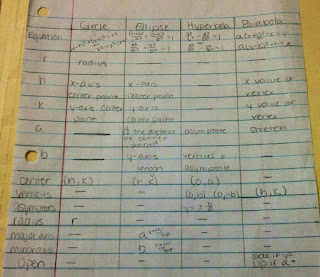
From here we did some basic practice (given equation - graph and describe, given graph- write equation and describe) and then it was time for the Photo Project. (up next)
To start, I asked students (in groups of 3) to sort the cards based on any characteristics they wanted and told them to be prepared to share. I did not include the general formula cards yet (actually I never did- I thought I would, but plans changed!). Most students sorted into three categories - graphs, descriptions, equations - first, then started matching the corresponding graphs and descriptions (including equations when they saw a vertical parabola) or creating subgroups of the original 3 categories. After having each group share a sorting method, I asked everyone to match graph, description and equation. We quickly ran out of time but students had started learning the vocabulary (major/minor axis, vertex, center) and at least one student was hooked - I heard him say "there's an equation for a circle?!" as I walked past. Students would later refer to the cards as a game, (a word I never used), so this student wasn't the only one engaged in the lesson.
The second day students spent the entire class matching graph, description and equation. I didn't tell them anything or have them focus on one type at a time. 90 minute blocks means plenty of time for them to dive in and figure things out on their own! They struggled to find ways to match the equation. Since this happened to be Day of Silence I made a list of options to show each group as they called me over in frustration (this was an awesome day to not be talking as I wanted them to struggle with the problem and look for patterns, but once they reached unproductive struggle I was happy to give them a push in the right direction).
- Find points on the graph and check them in the equations
- make a table from the equation
- rewrite the equation so it says y= and graph it in the calculator
Most groups went to the calculator and got some good practice with algebraic manipulation. Another note I used over and over was "you can't distribute a square root." By the end of 80 minutes most groups had a good chunk of their cards sorted (without any instruction on the equations whatsoever!). Part of my instructions at the beginning of class said "take notes on patterns and generalizations" but I realized that students had their desks covered with cards and hadn't taken out paper. With 10 minutes remaining in class I had everyone stop and make some notes with the reminder "the cards will be shuffled before you leave and next class is two days from now so you won't remember what you figured out!" Apparently my warning was insufficiently dire because they didn't have useful notes next class. With this in mind, I would switch up the order slightly and do the dichotomous tree activity first (below), then have students sort while building their key so there was a reason and a format for their notes.
The third class I started by handing every student a creature as they entered class. The dichotomous tree (link to original pdf) was on the board and they used it to identify their creature. I used creatures 1. because they were cute! 2. because no one started out knowing their creature's name so the tree was necessary.
 |
| sample creatures, can you name them? |
 |
| I know, dichotomy means 2 and I have one that splits into 3. One student coined the term di-trichotomous tree |
 |
| Yes, that is arabic. No, I don't have any idea what it says, I had to trust her! |

From here we did some basic practice (given equation - graph and describe, given graph- write equation and describe) and then it was time for the Photo Project. (up next)
May 18, 2013
Conics Unit: The Curves
I introduced conic sections with Paper Folding. After some searching I took bits and pieces from a couple activities (doc and pdf, respectively) to create my handout.
I folded some samples to make sure it would work. I found that I didn't need too many folds so long as they were well spaced along the line/circle. It's tough to write in pencil on wax paper, sharpie works much better (especially if you want to photograph your work). I didn't show students the models ahead of time because that would give away the surprise! But they were handy to compare the shape of my ellipse with someone else's to see how moving the focus effects the curve.


Patty paper is awesome if you have it. I somehow don't have any so I just used wax paper. Everyone gets a large section of wax paper to cut into fourths. That gives them one extra because mistakes happen (and you can't erase creases) and some students wanted to fold another ellipse with the focus in a different location to see exactly what would happen.
Since kids didn't know what shapes they were looking for, they needed more folds than I did. And then once they got started, some students were really ambitious and kept going until they got beautifully smooth curves.


Students started the packet in class and finished it for homework. They didn't always see the relationship and most students had a hard time figuring out and/or phrasing why the relationship was true, but those questions made for good class discussions. Since I recommended a size for the circle students noticed that their sum/difference was the same as their neighbors which was a nice segue into the realization that the radius was relevant. I'm not sure if having the same radius makes this fact more or less obvious. Thoughts?
The last question asks "Why conics?" and students said "cones...? I have no idea!" In one class I started by drawing a cone, then gave up and had everyone visualize a cone which I mimed slicing. They still weren't getting it so I did some searching and found this interactive applet. When I showed it everyone said "aha!" Armed with this information, I started with the applet in my other class, but they gave me the same blank stares the first group had pre-applet. I switched over to having them visualizing while I drew each slice and everyone said "aha!" I'm not entirely sure what the moral of this story is. Be flexible, have lots of tricks up your sleeve because it will take several explanations to get the idea across to everyone? Maybe the moral of the story is really that I need a solid cone with velcro slices. Does anyone sell such a thing?
Next up: equations!
May 16, 2013
Dilating Comics
I love coloring. I took drawing classes in high school but wouldn't call myself an artist. This project makes me feel like an artist, and I get to color. Plus, there's math and it's a "real life application" or whatever you want to call them (all math can be applied to real life!). The original idea came from a friend who had his students really dilate their images - onto poster board. He used a more vector-like method. My first incarnation used some math, this year there was more math.
Past Method:
Current Method:
Differences:
The scale factor is more obvious now. It was a pain to draw in the grid lines before (measuring is tough, then add in lining things up? Disaster.) Kids were less willing to plot tons of points this year (they had to calculate the new point rather than being able to count boxes) so some drawings didn't come out as well. However, they recognized that when the pre and post images weren't proportional it was because they'd free-handed that section.
Past Method:
- Trace comic panel onto small piece of graph paper
- Figure out how many boxes you need and divide 8.5 or 11 by that number (we actually used centimeters, but 21.5 and 28 aren't as recognizable of numbers)
- Draw in grid lines on the big paper
- Redraw comic panel on big paper by plotting some points and using the lines as guides
- Measure a few parts of each picture to compare, determine if it's proportional
 |
| My model |
Current Method:
- Trace comic panel onto small piece of graph paper
- Draw in some axes and choose 10 useful points, write down their coordinates
- Draw and label axes on the big paper (kids are tempted to change the scale- don't let them! one box = one unit on both small and large paper)
- Choose a scale factor that will allow your image to fit on a full size piece of graph paper
- Scale up your points and record them
- Redraw comic on big paper by plotting points and connecting, add more points as needed
- Measure a few parts of each picture to compare, determine if it's proportional
Differences:
The scale factor is more obvious now. It was a pain to draw in the grid lines before (measuring is tough, then add in lining things up? Disaster.) Kids were less willing to plot tons of points this year (they had to calculate the new point rather than being able to count boxes) so some drawings didn't come out as well. However, they recognized that when the pre and post images weren't proportional it was because they'd free-handed that section.
 |
| Actual student work |
 |
| This one too! |
May 4, 2013
Geometry Units

Plug for dropbox: I could pull up my outline for the year and my daily notebook files on my phone, which made it easy to figure out exactly how many days I spent on each unit this year.
There are topics on there I don't expect to get to this year. There are topics on there I can't imagine getting to next year. Sadly the topics will be dictated in part by the PARCC exam (and the emphasis of the exam may also flip some of the last 3 units because we don't end until late June and exams are in mid-May). Perhaps since the middle school is now focusing on middle school topics rather than Algebra 1, students will arrive with more geometry skills and Law of Sines will be within the realm of possibility. I am trying to keep an open mind, but I enjoyed taking the time to deeply explore those topics in PreCalculus so I really hope PARCC doesn't force it earlier.
There are topics on there I don't expect to get to this year. There are topics on there I can't imagine getting to next year. Sadly the topics will be dictated in part by the PARCC exam (and the emphasis of the exam may also flip some of the last 3 units because we don't end until late June and exams are in mid-May). Perhaps since the middle school is now focusing on middle school topics rather than Algebra 1, students will arrive with more geometry skills and Law of Sines will be within the realm of possibility. I am trying to keep an open mind, but I enjoyed taking the time to deeply explore those topics in PreCalculus so I really hope PARCC doesn't force it earlier.
Time is measured in class periods. We see kids for 90 minutes every other day. 180 day school year, every other day means 90 class meetings, 4 days stolen entirely by testing, 86 days to work with. 3 flex days each semester for review and performance tasks. The time for the unit includes regular assessments and needs to absorb the near constant interruptions of shortened days (every Wednesday next year, state testing, parent conferences...)
Our next step is essential questions and enduring understandings. What do you think are the most important aspects of each unit? Would you reorganize the units to better highlight something we're missing? Share in the comments or the google doc.
Our next step is essential questions and enduring understandings. What do you think are the most important aspects of each unit? Would you reorganize the units to better highlight something we're missing? Share in the comments or the google doc.
May 1, 2013
Matheme: Differentiation
Last night Kate gave a great Global Math talk about differentiation in math class. If you weren’t able to watch it last night, it was recorded and you can watch the video (and see our chatter!).
Julie and I want you to blog about differentiation, and then we will post a compilation on both of our blogs. So, if you would like to blog about differentiation, your post will be featured on both Julie's blog for MS Sunday Funday and the #matheme page.
To Submit your post on differentiation to both blogs:
1) Comment to this post or tweet your link to me (@crstn85). Include #matheme in your tweet.
2) Click here to submit your post to MS Sunday Funday. (Julie will post them next Sunday, May 12th.)
Can't wait to read what strategy you tried!
(cross posted on Julie's blog and Productive Struggle)
Subscribe to:
Posts (Atom)