Last year I wanted students to discover the area formulas of quadrilaterals by breaking them down into rectangles and triangles. Except, I didn't explicitly tell them that. Instead I assigned groups different quadrilaterals, told them to find the area of a few specific examples and then come up with a formula. It didn't go so well, although a couple groups did get where I'd hoped with little to no support. The rest of them balked at my vague instructions. I constantly struggle between providing so much support that no one has to think, and so little support that everyone gets so frustrated they can't think. Ashli posted a great quote about that recently: "The clearer you are about what you want, the more likely you are to get it, but the less likely it is to mean anything" -Dylan Wiliam
This year I took an online course in Geometry, Measurement and Technology where we had to write a lesson that used technology. I chose this topic for my lesson, but I struggled to make the tech useful and to decide how much support to give. I made my own applet on GeoGebra since I couldn't find one I liked (a learning experience on its own). I'm actually rather pleased with how the applet works and think that it has added value over paper since students can see so many examples and I can give them a much more subtle nudge to be sure they see the patterns. [overall instructions] [applet instructions] Now that the constraints of the online course are over I definitely plan to re-work the handouts I give to students so that they go in order (it was surprisingly difficult to manage two handouts that jumped back and forth plus a laptop). I will also restructure it so that students experiment in class and write a lab report for homework.
Side note: I'm aiming for one lab report per quarter, full write up, following the science department's format. I like doing them, but only enough to be willing to grade them four times a year. First quarter was parallel lines and a transversal via GeoGebra, second quarter was congruent triangle rules via NCTM, third quarter will be area formulas (this year it counted as a lab, no report, in my mind) and fourth quarter is still up for grabs. Maybe something trig?
The students who carefully read the instructions and completed each step were quite successful in working independently. This was an activity where I refused to answer most questions, instead directing them back to the typed instructions, their chart or the computer for further exploration. The tricky part about this activity is that most students have seen some of these area formulas before so they know what they're "supposed to get." It was a great experience for the students who chose a trapezoid and managed to start with rectangles/triangles, factor/simplify and end up with the familiar trapezoid formula. For those who didn't reach that point it seemed more contrived than our usual discoveries since they are used to discovering ideas they'd never seen before, as opposed to proving something they knew but didn't understand.
April 7, 2012


April 5, 2012
Patterns
Yesterday during lunch duty I was talking about what I really want to teach one of my classes*. I just introduced fractions last week and we did a lesson on ordering fractions last class. It involved putting fractions in order and then making observations. During the conversation I realized it is much more important to me that the students be able to recognize patterns and describe them, than to do anything more with fractions. So, then and there I decided we would spend some time studying a variety of patterns. Of course, I totally forgot until later that evening, but I asked twitter for ideas and they responded brilliantly to my request. So much so that I want to share with you exactly what they said (grouped by conversation, some liberties taken with ordering).
7:16 pm: Tina asks twitter for help
@crstn85 What's your favorite pattern problem accessible to basic math kids? Decided at lunch today to study patterns tomorrow but forgot until now!
7:16 pm: Tina asks twitter for help
March 31, 2012
Measuring by Magic: Shadows and Mirrors
We had some unusually warm weather a week ago and the kids were all clamoring to go outside; I said "next week" not realizing the temperature would drop so dramatically. I should have known - I've lived in New England my entire life - but I certainly wasn't going to start having class outside just because it was warm out in March! Imagine the begging I would hear in June... So, we measured using shadows when the thermometer read 30-something and opted to use mirrors in the lobby, where there was heat and high ceilings (the entryway spans all three floors).
Indirect Measurement
Before we headed outside, we looked at the diagrams and determined why this method would work. Similar triangles was an obvious answer since that's the unit we are on, but they know better than to just assume triangles are similar. Important facts: pick something that is at 90 degrees to the ground and on level ground (our flag pole is on an impossible to measure cliff), hold the meter stick vertical, the sun is reeaallly far away (doing this inside with a lamp would not work) and finally when looking in the mirror you must stand up perfectly straight. We neglected to mention accurate measurements, which I discovered when we got back to the classroom and some students were calculating in terms of feet with no spare inches. I'm pretending that's due to rushing in the cold (yes, I know the mirror activity was inside, fine, I'll note their inaccuracy when I comment on their work) and will be sure to mention it with my other classes next week. Overall it's a fun activity that gets kids looking at applications of math in a non-contrived way. I even went on a little tangent about just how hard it is to measure trees- tall, hard to climb, branches everywhere so even if you reach the top, how do you know how high you are?? Problems like these also encourage students to estimate and check how reasonable their solution is. We know the lamppost is taller than them but shorter than the building so the answer had better fit in that range.
Indirect Measurement
Before we headed outside, we looked at the diagrams and determined why this method would work. Similar triangles was an obvious answer since that's the unit we are on, but they know better than to just assume triangles are similar. Important facts: pick something that is at 90 degrees to the ground and on level ground (our flag pole is on an impossible to measure cliff), hold the meter stick vertical, the sun is reeaallly far away (doing this inside with a lamp would not work) and finally when looking in the mirror you must stand up perfectly straight. We neglected to mention accurate measurements, which I discovered when we got back to the classroom and some students were calculating in terms of feet with no spare inches. I'm pretending that's due to rushing in the cold (yes, I know the mirror activity was inside, fine, I'll note their inaccuracy when I comment on their work) and will be sure to mention it with my other classes next week. Overall it's a fun activity that gets kids looking at applications of math in a non-contrived way. I even went on a little tangent about just how hard it is to measure trees- tall, hard to climb, branches everywhere so even if you reach the top, how do you know how high you are?? Problems like these also encourage students to estimate and check how reasonable their solution is. We know the lamppost is taller than them but shorter than the building so the answer had better fit in that range.
March 26, 2012
Favorite Phrases
I seem to have an influx of visitors (Thanks Mimi and MathyMcMatherson!) so now seems like a great time to conduct the poll I've been planning. All teachers have a few key phrases that they use on a regular basis. They are verbal cues that your students learn to react to. I don't remember deciding on any of these, but they are the ones that I find myself saying over and over. A month or so ago I was visiting a friend who is an elementary school teacher and she had a sheet full of really corny call and response ideas to use with kids. As silly as they seem, I have no doubt they work. I wouldn't mind adding a bit of fun to my transitions or classroom repertoire, but none on the list felt right to me. That's where you come in!
Most Heard Phrases in my classroom:
"I need eyes up here and voices quiet" (by the time I say quiet, I'm speaking quietly)
"defend your answer" (the first few times I tell them to pretend to be lawyers providing evidence)
"use nice words" (when I hear anything that doesn't fit my definition of respectful)
I've used these three often enough that kids can both anticipate and complete them. I'm sure I have others, but these are the only ones that jump out as phrases where I use the exact same wording every time.
My co-worker uses a call and response where she says/sings "red robin" and they say "yummm" (and their mouths have to stay closed on the mmm sound). If the shoe fits... I hope those students don't arrive in my classroom next year expecting me to sing to them every day though, since that's really not me!
What are your favorite phrases? Did you pick them on purpose or did they happen organically?
Most Heard Phrases in my classroom:
"I need eyes up here and voices quiet" (by the time I say quiet, I'm speaking quietly)
"defend your answer" (the first few times I tell them to pretend to be lawyers providing evidence)
"use nice words" (when I hear anything that doesn't fit my definition of respectful)
I've used these three often enough that kids can both anticipate and complete them. I'm sure I have others, but these are the only ones that jump out as phrases where I use the exact same wording every time.
My co-worker uses a call and response where she says/sings "red robin" and they say "yummm" (and their mouths have to stay closed on the mmm sound). If the shoe fits... I hope those students don't arrive in my classroom next year expecting me to sing to them every day though, since that's really not me!
What are your favorite phrases? Did you pick them on purpose or did they happen organically?
March 21, 2012
Pi Day
This week is English MCAS (state test) week in Massachusetts. That means for 3 hours Tuesday, 3 hours Wednesday and 2 hours Thursday all the sophomores have to sit for exams that determine their eligibility for graduation. Then, they get sent off to class. Since I have almost all sophomores we postponed pi day by a week and celebrated on the 3 hour test days. I bribe my students with pie, but they do real math and we spend the 45 minutes productively, so I'm fine with it. Plus, they deserve the reward!
I started celebrating pi day at my first school, where it was actually a collaborative effort with a veteran English teacher. He had developed the method with some colleagues, but I wrote the worksheet to emphasize student thinking rather than providing all the steps and creating a mindless plug and chug activity.
Pi Day
Since we only had 45 minutes to both calculate pi and eat pie, I found we needed to do numbers 1 and 2 as a class. With more time I would give students the independence to figure it out themselves and work with them individually as needed. After question 1 I tell students to imagine that they are mathematicians in ancient times: they have noticed these equations seems to hold true for some constant, but they don't know that 3.14... is the correct value, how would they find this mystery number?
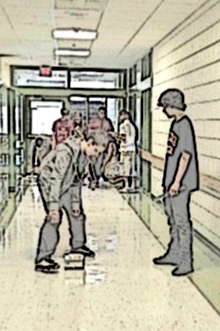
I think I have a lot more fun watching kids roll circular objects down the hall than they do crawling or crouching for 100 feet, but it gets them moving and maybe experiencing circumference helps them understand it? I also enjoy writing silly messages on the start, half way and finish lines (blue painters tape- easy to see and remove). One issue that comes up in every class is units. We have tiles that are 1 foot long so it was easiest for me to make the track 100 feet. In class I allow students to use cm or inches at their whim, so long as they are consistent with themselves throughout the activity, so many students measured diameter in cm. You can guess how well their value of pi came out!
When students finished their work they traded in their worksheet for a slice of pie (donated by our local grocery store- Shaws). This turned out to do much more than make sure each kid only got one slice of pie; it meant there was very little copying (I had the completed sheets) and I could direct students with questions to find a student who already had pie (an easy identifier).
While they were calculating and eating I played my favorite pi music.
I started celebrating pi day at my first school, where it was actually a collaborative effort with a veteran English teacher. He had developed the method with some colleagues, but I wrote the worksheet to emphasize student thinking rather than providing all the steps and creating a mindless plug and chug activity.
Pi Day
 |
| Photo run through SketchUp App |
I think I have a lot more fun watching kids roll circular objects down the hall than they do crawling or crouching for 100 feet, but it gets them moving and maybe experiencing circumference helps them understand it? I also enjoy writing silly messages on the start, half way and finish lines (blue painters tape- easy to see and remove). One issue that comes up in every class is units. We have tiles that are 1 foot long so it was easiest for me to make the track 100 feet. In class I allow students to use cm or inches at their whim, so long as they are consistent with themselves throughout the activity, so many students measured diameter in cm. You can guess how well their value of pi came out!
 | |
|
While they were calculating and eating I played my favorite pi music.
March 10, 2012
Consequences
I hate giving detention. I invite students to stay after school on a regular basis (notes on low test scores, weekly invite lists based on average grades, missing assignments or lack of progress on a long term project) but the consequence for not attending is merely that they continue to not understand or owe assignments. Giving detention for poor behavior makes me sad, because it says that my students don't respect me or their peers enough to change their behavior on their own. It says that students are acting appropriately because they don't want to stay after school, not because it's the right thing to do. Reaching this point makes me really disappointed in my kids, but also in myself- how could I have allowed students to get this far without establishing a relationship based on respect?
Here is the strange thing- I teach on a block schedule so we have classes A-D on Red days and E-H on White days, then the next day is a red day and so on. My red day classes are awesome. We can get serious, joke around, have conversations while we work, get off topic and then refocus. We have reached the sweet spot in the year when we all understand each other and class runs smoothly. My white day classes? If I give them a centimeter (not even an inch) they take a mile. They can't refocus or settle down or work independently. My regular geometry classes are at the same time of day - one red day, the other white day - but if someone observed one class and another person observed the other class they would have completely different impressions of my teaching and ability to run a class.
I realized last week that my F block was really getting out of hand so Friday I started class with a new seating arrangement and the prompt "Silently make a list of the characteristics of an A student." It did not happen silently but we started making a good list and almost had a good discussion about being born smart vs. working hard, but yet again a few kids kept shouting increasingly irrelevant things out while we were in the middle of a discussion. It ruins the momentum of any conversation when I have to stop to refocus students. I ended the conversation by telling everyone to pretend that they're an A student in class today. Somehow, class only got worse from there. Every other class I've used this prompt with has given me at least one good day. Apparently I need to cut back on the freedoms I allow them and start doling out consequences until we can get back to a state where the priority is learning, not random outbursts.
What do you do with a class that doesn't know what to do with a little bit of freedom and responsibility? I clearly need some help.
Here is the strange thing- I teach on a block schedule so we have classes A-D on Red days and E-H on White days, then the next day is a red day and so on. My red day classes are awesome. We can get serious, joke around, have conversations while we work, get off topic and then refocus. We have reached the sweet spot in the year when we all understand each other and class runs smoothly. My white day classes? If I give them a centimeter (not even an inch) they take a mile. They can't refocus or settle down or work independently. My regular geometry classes are at the same time of day - one red day, the other white day - but if someone observed one class and another person observed the other class they would have completely different impressions of my teaching and ability to run a class.
I realized last week that my F block was really getting out of hand so Friday I started class with a new seating arrangement and the prompt "Silently make a list of the characteristics of an A student." It did not happen silently but we started making a good list and almost had a good discussion about being born smart vs. working hard, but yet again a few kids kept shouting increasingly irrelevant things out while we were in the middle of a discussion. It ruins the momentum of any conversation when I have to stop to refocus students. I ended the conversation by telling everyone to pretend that they're an A student in class today. Somehow, class only got worse from there. Every other class I've used this prompt with has given me at least one good day. Apparently I need to cut back on the freedoms I allow them and start doling out consequences until we can get back to a state where the priority is learning, not random outbursts.
What do you do with a class that doesn't know what to do with a little bit of freedom and responsibility? I clearly need some help.
March 5, 2012
Miniatures in Proportion
I started doing this project back when I taught pre-algebra, but it's such fun that I continue to use it in my lower geometry class to review solving proportions before we get into similarity. My co-teacher and I scour our homes for miniature objects and end up with a pile of stuffed animals, toy cars, model trains, keychains etc. Students get to pick any object that they want to measure. Then, using just one dimension of the 'real life' object they have to calculate the other dimensions by assuming their miniature is proportional to the real thing. I started with slide 3, then when most people had several measurements I went through the example.
Miniatures
This year I happened to have the laptops in my room during the project, so we had them look up the 'real life' dimension (in the past I've just provided it on an index card). This allowed us to discuss what a reputable website was. I was disappointed to discover that my sophomores don't all know how to scan a google search and pick a good resource, but it did make me glad that my co-teacher had suggested including this step! The journal question at the end of class asked "How can you tell if a website is reputable?" and I've gotten some interesting responses. They vary from "if the website name isn't goofy" to "if you check the information with several sources" to "why would anyone post fake information about a fish?!" Internet research may be a topic we need to discuss again. That or I tell their history teacher to take care of it ;).
Miniatures
This year I happened to have the laptops in my room during the project, so we had them look up the 'real life' dimension (in the past I've just provided it on an index card). This allowed us to discuss what a reputable website was. I was disappointed to discover that my sophomores don't all know how to scan a google search and pick a good resource, but it did make me glad that my co-teacher had suggested including this step! The journal question at the end of class asked "How can you tell if a website is reputable?" and I've gotten some interesting responses. They vary from "if the website name isn't goofy" to "if you check the information with several sources" to "why would anyone post fake information about a fish?!" Internet research may be a topic we need to discuss again. That or I tell their history teacher to take care of it ;).
Subscribe to:
Posts (Atom)